Showing posts with label TED. Show all posts

Friday, January 8, 2010

TED Friday: Global Ethic Vs. National Interest

Every Friday I will watch a Technology Entertainment and Design Conference (TED) talk and apply the ideas in that talk to space habitation.

There is a dilemma every country has to face. What should a nation do when there is a choose between helping themselves and helping the world? Should national interest take priority over global responsibilities?

This was the subject of the TED talk Global Ethic Vs. National Interest an interview with British Prime Minister Gordon Brown hosted by TED Curator Chris Anderson.

The Prime Minister brought up a good point, “I think one of the problems of a recession is that people become more protectionist, they look in on themselves, they try to protect their own nation, perhaps at the expense of other nations”. So, lets assume every nation was spacefaring at the beginning of the recession. It is probable that we would have stopped sharing technology and began a land grab on the moon. Especially as each nation’s space program’s funding was threatened.

However, the Prime Minister brings up another good point, “And any nation that would become protectionist over the next few years would deprive itself of the chance of getting the benefits  of growth in the world economy”. So, in my scenario, when every nation competes with each other, they all loss the accelerated development due to sharing information. They all loss each other’s aid in the event of a disaster. They all loss the power of pooling their resources into one big mission.

See, when we prove that our long term interests are the same, we will work with each other. National interest almost always wins in the short term. Especially when it comes to spending money, but is global responsibility is viewed as an investment, then it’s easy to sacrifice national resources for humanity. Hopefully, this logic will lead into people funding space habitation.

We also lack a international organization for space. Space emergences must be reported to the Secretary General of the UN and the nation whose ship is in distress. But that is the limit to a real international partnerships. Yes, I know there are joint missions, but these feel like temporary mission rather then a consistent motion towards international space access.

Reactions

-Do you think the Outer Space treaty going against national interest?

Resources

Brown, Gordon. "Global Ethic Vs. National Interest" December 2009. Online video clip. TED. Accessed on January 10, 2010. <http://www.ted.com/talks/gordon_brown_on_global_ethic_vs_national_interest.html>


Creative Commons License


Sunday, December 27, 2009

An Energy Based Argument for Space Habitation

In his Technology, Entertainment and Design (TED) lecture, Rob Hopkins reminds us the oil is limited and that we must transition to a world without it so we can wean ourselves off oil now. During the lecture, there was a graph that stunned me...


Energy Vs. Time in Space Habitation

This is a graph of time verses energy availability.


While the audience too all of this in, Rob said, while holding a jar full of oil…


“This bottle of oil, distilled over a hundred million years of geological time, ancient sunlight, contains the energy equivalent of about five weeks hard human manual labor -- equivalent to about 35 strong people coming round and working for you. We can turn it into a dazzling array of materials, medicine, modern clothing, laptops, a whole range of different things. It gives us an energy return that's unimaginable, historically.  We've based the design of our settlements, our business models, our transport plans, even the idea of economic growth, some would argue, on the assumption that we will have this in perpetuity.

Yet, when we take a step back, and look over the span of history, at what we might call the petroleum interval, it's a short period in history where we've discovered this extraordinary material, and then based a whole way of life around it. But as we straddle the top of this energy mountain, at this stage, we move from a time where our economic success, our sense of individual prowess and well-being is directly linked to how much [oil] we consume, to a time when actually our degree of oil dependency is our degree of vulnerability.”

In order to be safe, we must assume this energy model is right and we must seek out a equally powerful source of energy. This source of energy can be found in space. Solar power is more efficient in space and He-3 is available in space. However, this promised land of energy requires energy to reach.

This is why the petroleum interval must be the time where humanity executes space habituation. We must use are abundance of energy now to secure energy for the future. The shuttle uses over 20 terajoules of energy in its launch. That is 4.78011472 × 10^9 Kilocalories. That’s the energy stored in 153847 gallons of gasoline (1). Plus, you have to combine the energy to move the shuttle to the launch pad, the energy required to push all the data NASA generates during every launch, the energy NASA workers use in commenting, the energy costs to create the special fuel for the shuttle, and so on and so on. This is multiplied when we increase the number of rockets launched when space habitation occurs. These are mind boggling amounts of energy that are trivial this age of abundant energy, near infinite energy. In other words, NASA does not have to worry about the energy it needs to launch rockets not being available.

However, once we leave this planet’s gravity well, we once again have access to near an abundant source of energy. Thus, we must inhabit space now.


Source:

1: “Page Untitled.” Syracuse University. Web. Accessed on 27 December 2009. <http://physics.syr.edu/courses/modules/ENERGY/ENERGY_POLICY/tables.html>

Hopkins, Rob. "Rob Hopkins: Transition to a world without oil" Nov. 2009. Online video clip. TED. Accessed on 27 December 2009. <http://www.ted.com/talks/lang/eng/rob_hopkins_transition_to_a_world_without_oil.html>

Tuesday, August 11, 2009

How Consumerism Blocks Space Habitation

The free rider problem is the most used argument against space habitation. I think this argument makes sense in the context of consumerism because the consumer does not care about the society. Let's look at this quote from the TED talk James H Kunstler dissects suburbia:

One final thing -- I've been very disturbed about this for years, but I think it's particularly important for this audience.  Please, please, stop referring to yourselves as "consumers." OK? Consumers are different than citizens. Consumers do not have obligations, responsibilities and duties  to their fellow human beings.  And as long as you're using that word consumer in the public discussion,  you will be degrading the quality of the discussion we're having. And we're gonna continue being clueless going into this very difficult future that we face.

To the consumer, the free rider is a problem because the consumer is focused on the net effect for individuals of a society. But the citizen is focused on the net effect for the society. Space habitation is great for society, but the benefits might take longer to come to some individuals then others.

2041408420_0eb8929994

I say consumerism blocks space habitation, as opposed to space development, because consumerism will drive the destructive economic exploitation of space. If we exploit space, as opposed to using it in a non-destructively, we will be repeating the same mistake that humanity has been committing since the dawn of time.

Reactions

-Can consumerism help space habitation?

Resources

Photo by roland

Kunstler, James H "James H Kunstler dissects suburbia" February 2004. Online video clip. TED. Accessed on August 11, 2009. < http://www.ted.com/talks/lang/eng/james_howard_kunstler_dissects_suburbia.html >

In Case You Skimmed

  • Consumers are not concerned about their neighbors
  • So, they will not support space habitation since it may not directly benefit them 

Creative Commons License

Thursday, August 6, 2009

Defining Success in the Space Faring Society

In Alain de Botton's TED (Technology, Entertainment, Design) talk, titled A Kinder, Gentler Philosophy of Success, Alain de Botton points out the link between our views on success and how we feel about ourselves. He tells us in his talk why a meritocratic society forgets about the randomness of success. I think the space faring society will have an even more extreme version of meritocracy then today. Assuming the interstellar spaceship is the symbol of a space faring society, then that society will think that anyone can do anything. Think of the ideal spaceship; the spaceship of Star Trek. This spaceship is very defiant, it overcomes gravity and thumbs its nose at the laws of physics with its warp drive. The radiation that keep man from exploring space is laughed at with its energy shields. Nothing can stop an ideal spaceship.

619307160_019d96a443_b

If the spaceships of the space faring society influence the development of that society, then we might have a problem. If the society is influenced by the spaceship then we might see bigger expectation that one is successful, far greater then what is seen today. Simply because the ideal spaceship has nothing stopping it from achieving greatness; only poor maintenance or a poor crew can stop it. This might cause the society to think nothing stops a person from success except for personal weakness. I'm speculating with this post, but I'm really curious about how a space faring society will think about success.

Reactions

-Will a space faring society have an extreme view on success?

Resources

Photo by aloshbennett

Botton, Alain de. "A Kinder, Gentler Philosophy of Success" July 2009. Online video clip. TED. Accessed on August 06, 2009. <http://www.ted.com/talks/alain_de_botton_a_kinder_gentler_philosophy_of_success.html>

In Case You Skimmed

  • The characteristics spaceship with be reflected in the believes of a society
  • A space faring society, because a spaceship can easily overcome obstacles, might think that everyone can overcome their obstacles  

Creative Commons License

Monday, July 20, 2009

Space Settlement, Social Media and Blogging

Happy Space Settlement Blog Day. Today we celebrate the 40th anniversary of the Apollo 11 moon lands, not with a party on Moon Base Alpha, but with writing blog posts explaining why we should build a space settlement, about space habitation and on space settlement in general...

Yea... go humanity... we are so... epic... -.-

(Nothing against Space Settlement Blog Day, it's a cool idea, but humanity has epic failed by leaving the moon's surface for so long. The National Space Society is great, humanity epic fails. We should be partying on the moon.)

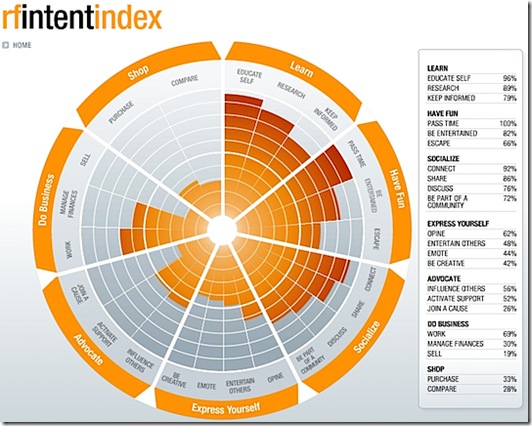
So, I'm going to tell you how social media and blogs will convince humanity of the importance of space settlement. Today, Problogger posted this...
rfintentindex

This where Problogger got this image. 100% of this sample of 500 went online with the intention to pass time; in other words, they went online because THEY WERE BORED. However, only 26% of the sample went online because they wanted to join a cause. So, how do blogs and social media fit into promoting the idea of space habitation and recruiting more members into the space movement? Blogs about space habitation and blogs which talk about space habitation occasionally are very good at connecting to bored people who want to educate themselves or do research for fun. The very best blogs break down complex subjects and make them easy fro the average reader to grasp. If we could draw in a few bored (you have to be really bored to read my blog) people with space settlement blogs and educate them on the subject of space settlement, then we have planted a seed. They may not activate their support then and there, but they will not be opposed to the idea of space settlement with an effective blog; with an effective argument.

This is why I believe that whenever someone is against this idea of space settlement or against funding NASA or against manned space flight in general, it is my fault and the space community's fault. 96% of the people who go on the Internet go on the Internet with the intention for educating themselves. We have to grab that by the horns, we have a audience who will stay around if we teach them because they want to be taught. Blogs, with their oven fresh content, keep bringing in these people who want to learn. Blogs tap into this wandering student; the common Internet user don't wander to NASA's website. Ok, maybe some do, but blogs are geared toward this wandering audience because are jobs is to translate technical writing into non-technical writing. The common Internet user is less likely to wander into a NASA study and read it then a blog reporting on the study. Hopefully, the blog will present the study in a way that the wonderer will read.

What social media and blogs provide the space community with is one of the most effective tools we could ever have; we can provide anyone with the slightest interest in space settlement an expert in the field, or at least a space cadet like me, to have a one-on-one conversation. Recently, I got a Google alert from someone asking on his Live Journal "what's the point of space settlement". I was able to tweet this request and get the many space cadets on twitter to give him an answer, a very clear answer. That's the power we hold with the tools the Internet provides us. We can also craft a more convincing argument for space settlement...

And the premise of "The Wisdom of Crowds" is that, under the right conditions, groups can be remarkably intelligent. And they can actually often be smarter than even the smartest person within them. The simplest example of this is that if you ask a group of people to do something like, guess how many jelly beans are in a jar. You know, if I had a jar of jelly beans, and I asked you to guess how many jelly beans were in that jar,  your average guess would be remarkably good. It would be somewhere probably within three and five percent of the number of beans in the jar,  and it would be better than 90 to 95 percent of you. There may be one or two of you who are brilliant jelly bean guessers, but for the most part the group's guess would be better than just about all of you. And what's fascinating is that you can see this phenomenon at work in many more complicated situations.

So, for instance, if you look at the odds on horses at a racetrack, they predict almost perfectly how likely a horse is to win. In a sense, the group of betters at the racetrack is forecasting the future, in probabilistic terms.  ~James Surowiecki on the turning point for social media

You see, with all these blogs about space and space settlement, we will find out what the public likes and does not like. We can demo new ideas and the ideas which fail are not the ones which will make space settlement reality. In fact, the best blog post submitted for Space Settlement Blog Day should be turned into a pamphlet because it will be one of our better arguments. But, we do have a problem...

So, the ant colony is a great model -- you have all these little parts that collectively add up to a great thing. But we know that occasionally ants go astray, and what happens is that, if army ants are sort of wandering around and they get lost, they start to follow a simple rule -- just do what the ant in front of you does.  And what happens is that the ants eventually end up in a circle. And there's this famous example of one that was 1,200 feet long and lasted for two days, and the ants just kept marching around and around in a circle until they died. ~James Surowiecki on the turning point for social media

So, blogs could bring the death of the space movement. We might end up retweeting and linking to a deadly idea for the movement. This can be adverted by making sure everyone knows where they are going, but the possibility is still there.

So, in short, blogs can create a discussion about space settlement and that is what will get this idea engrained in humanity's culture. If space settlement becomes a cultural goal of humanity, it is sure to happen.

Reactions

-What other disadvantages can blogs bring to the space movement?

-Have you participated in a discussion of space settlement on the web? How did it go?

Resources

"rfIntentindex" Ruder Finn Intent Index. rfrelate. Article date unknown. Web. 7/20/09

Surowiecki, James. "James Surowiecki on the turning point for social media" Nov. 2008. Online video clip. TED. 7/20/09.

In Case You Skimmed

-The people on the Internet are all willing to listen to our pitch

-Bored people tend to go to blogs

-Blogs and social media can create conversations about space settlement

-These conversations will make the space movement stronger

Creative Commons License

Saturday, June 20, 2009

Space Habitation as a Stabilizer for the Future

Space habitation will be a stabilizer for the future. Instead of fearing the future, we will look forward to it. I look forward to tomorrow and the change it will bring, but this is a rare opinion. So many people are caught up in maintaining the status quo. This is a problem, because the world is changing. I was frighten at first when I watched the TED talk Pete Alcorn on the world in 2200, but then I got even more hopeful.

2440038886_0415afcf98

Photo by ATIS547

We our population will drop as we reach the population cap. I can tell you now that the child-free movement is strong in my generation. It will alone increase as we hit that cap, are population will drop. If we do establish a space habitation, then the history humanity will not have been a slide down from the good old days. I'll argue that the days of space habitation will be on par with the days where humans lived in the Garden of Eden. At least comparable; giving humanity a sense that we are improving will make us a more confident specious. If humanity has a mindset that we are getting worst, then I doubt very many people would be motivated to do much.

Without space habitation, without the field of space, our future looks ugly. I dare you, I triple dog dare you to imagine a future without space. If you managed to do that, romantize it. It can be done, but space is a lot easier to get people excited about.

It will also allow people to prepare for the population decline. The moment space travel become affordable, everyone who can will move to the Moon or Mars. In my opinion, there will be a mass exodus. If money wasn't a factor in accessing space I would not find a single person who did not want to live in space... ok, their would be those who are sentimental about Earth and would stay and those who are hesitant because of safety, but that group would be outweighed by the people going.

In short, space habitation gives us a positive view of the future that will get us through the next 150 years.

Wednesday, June 17, 2009

Wisdom in Space Habitation

While doing research for my education philosophy paper (my final paper for high school, wooot), I came across the TED talk The real crisis? We stopped being wise given by Barry Schwartz. I think his words can be applied to any field, any task and every action we take. Incentives and punishments, as Barry Schwartz points out, do not work. I feel they will not work in space. But, this is what makes human space flight special. I feel those who are in the space field have a certain wisdom. It's found outside of this field, yes, and, yes, there are a few dull bulbs in the space flight. But, I feel that the vast majority of the people in space will resonate with Barry Schwartz's words. Not just agree with him, but feel a connection to his argument the runs down to the soul. This philosophy must be buried deep within the space habitation movement because it will guide us on unmade trails and unknown obstacles.

2766737671_e32d0c0113_b

Photo by alicepopkorn

Here's the video if you want to watch it. It's 20 minutes long, so I quoted the best parts for this blog post. But, Barry Schwartz is a great speaker and really makes a convincing argument. Plus, it makes my job easier if you watch it. Your time will not be wasted by watching this video... relative to the other youtube videos that we all know you watch. 

Real-world problems are often ambiguous and ill-defined and the context is always changing. A wise person is like a jazz musician -- using the notes on the page, but dancing around them, inventing combinations that are appropriate for the situation and the people at hand.

The space program has ignored the rules. The Apollo-Soyuz Test Project is my primary example. This project occurred, not only during the cold war, but in the same year of the Vietnam war, which was basically a war between the USSR and the USA, but with puppets. If NASA and the Soviet Space Program followed the rules, we would have seen the first war in space. Both sides where trying to stop the spread of the other's ideologies and, if the programs followed the textbook, they should have gone to war, at the very least ignore the other side. But, this was not done. They talked to each other. These two countries who where just at war and had nuclear weapons aimed at each other had their astronauts and cosmonauts shaking hands in space. Americans climbed in to Russian vehicles and visa-versa. This shouldn't have happened. The administrators and engineers of both space programs showed incredible wisdom though this act. If we continue to toss out the rules in space, we will see a multinational team in the first space habitation. Because the rules still say we should be fearful of other nations. I believe, after man achieved the Apollo-Soyuz Test Project, that space programs will ignore these social rules - the very rules which will lead to humanity's destruction. 

In Switzerland back about 15 years ago they were trying to decide where to site nuclear waste dumps. There was going to be a national referendum. Some psychologists went around and polled citizens who were very well informed. And they said, "Would you be willing to have a nuclear waste dump in your community?" Astonishingly, 50 percent of the citizens said yes. They knew it was dangerous. They thought it would reduce their property values. But it had to go somewhere and they had responsibilities as citizens. The psychologists asked other people a slightly different question. They said, "If we paid you six weeks' salary every year would you be willing to have a nuclear waste dump in your community?" Two reasons. It's my responsibility and I'm getting paid. Instead of 50 percent saying yes, 25 percent said yes. What happens is that the second this introduction of incentive gets us so that instead of asking, "What is my responsibility?" all we ask is, "What serves my interests?"

It's because of the above quote that I fear the promise of fortunes in space will be the Achilles heel the space habitation movement. In my experience of talking to others about space habitation, claiming that we should have a space habitation because it cool is a much more effective argument then human extinction or profit. Simply put, incentives and punishments will not power the space habitation movement. They will give us creditability, but something will be at the core of our mission. I don't know what it is, the space habitation idea hasn't lived this long because it cool. We need a rallying call, a moral obligation that space habitation fulfills. Again, I'm not sure what it is, but this obligation has keep this dream alive for many year, it will lead to it's fulfillment.

So I want to know, what did you take from this video. 

Related Posts with Thumbnails