Showing posts with label Multi-generational planning. Show all posts

Thursday, February 4, 2010

CAT: Political Cycles

Welcome to Counter Argument Thursday (CAT). This is where I write blog post the is opposite and critical of my position on space habitation and space habitation. I do not agree with the position in the blog post, but it is an argument I need to address.

Space habitation is a dream that cannot survival the vicious political cycles in modern government structures, just like every plan that takes multiple generations. space habitation will take at least two generations. Even a moon base takes 30 years to build, as claimed in the paper Lunar Industries and Their Value for the Human Environment on Earth. I can’t even claim there will be long term political stability in a totalitarian state, they too have political cycles.  In fact, unless a long term goal in woven into the social fabric of a nation, it won’t get done. Furthermore, to be blunt, space is far from being woven into the social fabric of, at least, the United States. I offer the Rasmussen Reports article 50% Favor Cutting Back on Space Exploration as proof. If a moon landing can’t make space into a social goal, nothing can. Thus, there will be progress toward space habitation while it is politically favorable and that progress will be halted when the tides turn.

In Case You Skimmed

-Space habitation is a long term goal the requires political stability.

-Political stability simply doesn’t exist

Reactions

-Could an international organization offer the political stability needed to space habitation?

-Could space habitation research hibernate in academia during politically rough times, only to reemerge better then ever when the public is ready?

-Will there be funding for space habitation in academia during politically rough times?

-Will there be a student interest in space habitation during politically rough times?

Resources

Krafft A. Ehricke, Lunar industries and their value for the human environment on Earth, Acta Astronautica, Volume 1, Issues 5-6, May-June 1974, Pages 585-622, ISSN 0094-5765, DOI: 10.1016/0094-5765(74)90023-X. (http://www.sciencedirect.com/science/article/B6V1N-4805SJ8-5/2/4d9bdc1efb4a1a033b97f934b0fe09e8)

Rasmussen Reports, “50% Favor Cutting Back on Space Exploration” Weblog entry. Rasmussen Reports. January 15, 2010. January 18, 2010 <http://www.rasmussenreports.com/public_content/lifestyle/general_lifestyle/

january_2010/50_favor_cutting_back_on_space_exploration>


Tuesday, September 15, 2009

Using Space Habitation to Buy Time

In Sunday Paper Club #14 I think I was harsh on the paper I reviewed. I used a quote from the matrix to disprove the paper’s point that space habitation must be implemented to keep on living the way they are living now. Again, here is the quote from The Matrix

I'd like to share a revelation that I’ve had during my time here. It came to me when I tried to classify your species, and I realized that humans are not actually mammals. Every mammal on this planet instinctively develops a natural equilibrium with the surrounding environment; but you humans do not. Instead you multiply, and multiply, until every resource is consumed. The only way for you to survive is to spread to another area. There is another organism on this planet that follows the same pattern... a virus. Human beings are a disease, a cancer on this planet, you are a plague, and we... are the cure.

We humans only realized, relatively recently, that we are not in equilibrium with our environment. But, there are so many entrenched ideas that will prevent us from reaching equilibrium for a while. We have to reinvent human society to come into a balance. I’m guessing that will take at least 10 generations. We might not be able to ensure that humans will live forever if we wait on this planet. We need to buy some time to establish a equilibrium, moving into space will allow us to get an equilibrium with our environment without killing ourselves on Earth. 

Reactions

-Can we establish an equilibrium while remaining on Earth?

Resources

The Matrix. Dir. Larry and Andy Wachowski. Wachowski brothers. Warner Bros. Pictures, 1999. 


In Case You Skimmed


-There is a lot of waiting involved with space habitation, thus the public will loss interest in space habitation.


Creative Commons License

Sunday, September 13, 2009

SPC #14: The Cultural Imperative to Colonize Space: An Astrosociological Perspective

Welcome to the Sunday Paper Club. (Almost) every Sunday, this blog will offer analysis of a paper on space habitation and other related topics. These are my opinions on a weekly scientific paper; basically I read the paper and write down my thoughts are I read it. They are subject to my perspectives and believes. I am open to debate, so if any reader believes I have misinterpreted something in a paper, please point it out. I'm only a student and I'm still learning how to read these papers and interpret them. All quotes are from the paper unless otherwise noted. All papers I review are available for free online.

This week we are reviewing The Cultural Imperative to Colonize Space:An Astrosociological Perspective.

The paper’s first main point is how humans are drawn to space more then the bottom of the oceans. This is due mainly to the culture defining aspect of space. I urge you to look at table 1 on page 4. As you will see, the way we viewed, for example, Mars effected the way society operated.

The main point of the paper is to point out how space habitation is needed to sustain the way that humans live. But, while reading this paper, I was reminded of this quote in The Matrix

I'd like to share a revelation that I’ve had during my time here. It came to me when I tried to classify your species, and I realized that humans are not actually mammals. Every mammal on this planet instinctively develops a natural equilibrium with the surrounding environment; but you humans do not. Instead you multiply, and multiply, until every resource is consumed. The only way for you to survive is to spread to another area. There is another organism on this planet that follows the same pattern... a virus. Human beings are a disease, a cancer on this planet, you are a plague, and we... are the cure.

The whole point of this paper is null and void if humans are able to change they way they live. A simple change in mind set, from a short term one to a long term one, could be enough to save humanity. It might even be so much that space habitation is not needed. The question is “can humans develop a natural equilibrium”? We also must learn how to not waste opportunities.

Manned space flight is like the wheel, it is game changing. It will completely redefine everything about human life. But “The Aztecs… had the wheel, but only used it in the construction of toys and in their calendars. There is
likely an assortment of mundane explanations for the failure of the wheel to diffuse across other sectors of Aztec
society”. The critical part of that quote is contained in two words “mundane explanations” (Read: the day-to-day actions of the members of Aztec society). It is nothing more then that. Nothing more prevented the Aztecs from saving themselves from collapse. They had a huge advantage.

Why does that sound so familiar…

I remember, humanity’s space activity is a mix between a recruitment ad for scientists and engineers and a power grab by the leaders of various nations.  Yes, we need more scientists and engineers, but that is an inherent quality about all space activity. We can move on to bigger, betting things and use the ground breaking technology to change the game.

Last, but not least, the paper suggests a vast increase in education funding. But, the only way we can get the money is if we over come the vast anti-intellectualism in the world.

Reactions

-Can humans become less virus like?

In Case You Skimmed

-If human society remains the same, then we need space habitation.


Creative Commons License

Friday, September 11, 2009

Engineers as Public Relations Officers

Engineers as inherently focused on details. In my last post I used Seth Godin’s work support the argument that the public is looking for detail in the plans it supports. If this is true, then engineers must take the role as the public relations officers of the 21st century. The public wants every step of a plan, they no longer want only visions of the future. You can not ask the public “do you want to go back to the moon” and expect support. You can expect increased support when you ask for support when you can show all the math, all the technology and all the money which you are basically your plan off of.

Reactions

-Does the public’s response and support of the 2012 doomsday theory could weaken this argument?

Resources

Godin, Seth. "Achievable Avalanche Opportunities
Seth Godin’s Blog. 8 September 2009. Web. 8 September 2009.

<http://sethgodin.typepad.com/seths_blog/2009/09/achievable
-avalanche-opportunities.html>.


In Case You Skimmed


-In short, the public wants well planned goals, not visions dripping with Kool Aid.


Creative Commons License

Wednesday, September 2, 2009

Public Relations, Herculean Efforts and Space Habitation

Seth Godin posted a thought on how enormity (something that is really horrible) is a bad marketing tool because people stay away from huge problems which are have horrible consequences. Mr. Godin pointed out how infomercials asking for donations starving and sick kids are ineffective because the problem is huge. If the problem was small, people would rush to help, but ending world hunger is a massive task.

So would space habitation. Based on Seth's post, I think the size of space habitation is pushing people away from the idea of space habitation. "If [we've] got a small, fixable problem, people will rush to help, because people like to be on the winning side, take credit and do something that worked." 1. There is no away we can make space habitation easier, it is going to be a macro-engineering project regardless of the planning. But, in order to increase public support, we can make the public fell like the pro-space habitation side is the winning side. We have to give our supporters credit and parade them as supports and we MUST prove that this will work. That's hard for us because space habitation is a multi-generational plan. Current supports can't stand on the finish line. Maybe we can give each generation a goal in the path to space habitation to reach, but we must give people the 3 things Seth Godin points out to get them to help to build space habitation.

Reactions

-Can people who will not be alive when the team wins still fell like they are working on something valuable?

Resources

Godin, Seth, “Enormity" Weblog entry. Title of Weblog. September 02, 2009. http://sethgodin.typepad.com/seths_blog/2009/09/enormity.html

In Case You Skimmed

  • The amount of work needed for space habitation to work is scaring people away from space habitation.

Creative Commons License

Friday, August 28, 2009

Space Habitation Is Urgent

Stephanie B, author of the blogs Ask Me Anything and Rocket Scientist posted this comment on yesterday's post:

Urgency is a relative term. If we WILL need something 30 years down the line but it takes 30 years to get there, it is urgent.


If we need something a hundred years from now and we can get there in thirty years, it's not urgent.


The problem, of course, is that (a) predicting how long it will take to get there can change depending on urgency and technological breakthroughs and (b) no one knows how soon the needs will become critical and (c) no one really knows how long it would take to get there.


There's too much speculation for me to have a definitive opinion.~ Stephanie B

She is right, that there is a lot of speculation here, but, after reading her comment, I was convinced that space habitation was more urgent then what I previously thought. Let's assume if we do not have space habitation when we need it then bad things will happen. Since we do not know how long it takes to achieve space habitation and when it will become a need, we have to assume it is urgent to avoid the consequences of not having space habitation when we need it.


Someone needs to give her a raise. For more brilliant ideas like the above comment, check out Ask Me Anything and Rocket Scientist.

Resources

Stephanie B. "Urgency is a relative term" [Weblog comment.] August 28, 2009. Type 1 and Type 2 Engineering. Aron Sora. Habitation Intention.  August 28, 2009. (http://habitationintention.blogspot.com/2009/08/type-1-and-type-2-engineering.html) August 28, 2009.

In Case You Skimmed

  • Since we do not know when we will need space habitation, we must assume it is an urgent need.

Creative Commons License

Saturday, August 22, 2009

This is Why Space Habitation Isn't Getting Off the Ground

"Consumers want high tech industrial products first, then they demand "services." such as: health insurance, child care, education, pensions, stock funds, insurance, ect." ~ Social Problems in Global Perspective

This quote is bad for space habitation. First, it shows the short term nature of decisions the consumer makes. The people we have to convince for space habitation to get off the ground are mostly consumers. All the services listed above and be defined as long term investments. Basically, the consumer doesn't make long term investments. Space habitation would be the ultimate long term investment; the biggest long term investment humanity has ever made. Furthermore, if consumers don't see the value in basic insurance, then any argument for space habitation that using human extinction will be ineffective.

Second, it shows the lack of attention to education, which will be a very critical part of a spacefaring society. If people want to buy and iPhone before they want to buy a book, we can't possibly hope to generate enough skilled labor and Engineers to take on space habitation.

Reactions

-Is it good people are focused on high tech industrial products first? Can't that focus be used to get kids excited about science, technology, math and engineering?

Resources

Glassman, Ronald M., William H. Swatos and Barbara J. Denison. Social Problems in Global Perspective. Maryland: University Press of America, 2004.

In Case You Skimmed

-Consumers are focused on toys more then the future, thus it will be hard to convince them to support any long term or multigenerational plan.

Creative Commons License

Tuesday, August 18, 2009

XKCD Teaches a Lesson About Colonization

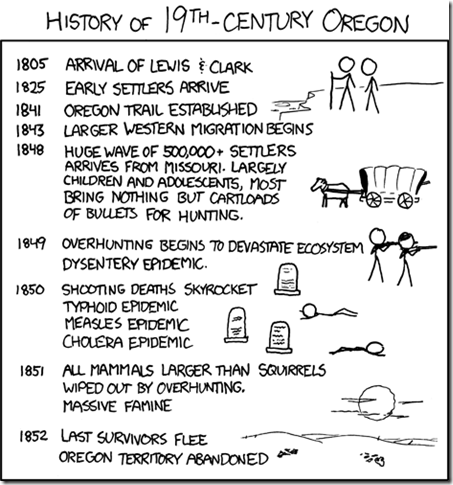
XKCD posted this a couple of days ago:

oregon

Yes, I know, this comic a joke, but I saw a connection between this comic and space colonization. (Wow, I'm such a space cadet, I can't read anything without connecting it to space) This comic reinforces my fear: I fear the destructive exploitation of space will destroy the opportunity space provides humanity. This comic represents what the plans for space habitation must avoid. When we go to inhabit space, we can't bring nothing but tools to exploit space. We must bring tools to replenish the things we take, to repair the damage that we cause and to make our efforts sustainable. Otherwise, we will be in the same pile of fail that we find ourselves in here on Earth when we move into space.

When we move into space, we need to not be blinded by the dollar signs that twinkle in every star, because that will lead to short term planning. We need to plan for the epidemics and other problems that may occur in space and not have a money blinded race into space. That's why I avoid the word space colonization, I feel it is to focused on money, so focused on money that it is destructive. That's is what I want humanity's journey into space to avoid. Yes, we can all get rich off space, but don't let that blind you from the dangers, the difficulty and the future. That's what profit blinded those Oregon settlers to.

Reactions

-Do you think I'm wrong?

-Does space habitation need to focus on profit to motivate people to get off the planet?

In Case You Skimmed

-Space habitation must focus on the long term.

-Space habitation efforts can be blinded to long term consequences by the riches of space.

Creative Commons License

Saturday, June 20, 2009

Space Habitation as a Stabilizer for the Future

Space habitation will be a stabilizer for the future. Instead of fearing the future, we will look forward to it. I look forward to tomorrow and the change it will bring, but this is a rare opinion. So many people are caught up in maintaining the status quo. This is a problem, because the world is changing. I was frighten at first when I watched the TED talk Pete Alcorn on the world in 2200, but then I got even more hopeful.

2440038886_0415afcf98

Photo by ATIS547

We our population will drop as we reach the population cap. I can tell you now that the child-free movement is strong in my generation. It will alone increase as we hit that cap, are population will drop. If we do establish a space habitation, then the history humanity will not have been a slide down from the good old days. I'll argue that the days of space habitation will be on par with the days where humans lived in the Garden of Eden. At least comparable; giving humanity a sense that we are improving will make us a more confident specious. If humanity has a mindset that we are getting worst, then I doubt very many people would be motivated to do much.

Without space habitation, without the field of space, our future looks ugly. I dare you, I triple dog dare you to imagine a future without space. If you managed to do that, romantize it. It can be done, but space is a lot easier to get people excited about.

It will also allow people to prepare for the population decline. The moment space travel become affordable, everyone who can will move to the Moon or Mars. In my opinion, there will be a mass exodus. If money wasn't a factor in accessing space I would not find a single person who did not want to live in space... ok, their would be those who are sentimental about Earth and would stay and those who are hesitant because of safety, but that group would be outweighed by the people going.

In short, space habitation gives us a positive view of the future that will get us through the next 150 years.

Tuesday, June 9, 2009

Fear in Space Habitation Pt. 1

I've noticed I've been posting alot on human extinction and I'm using that argument as my flag ship argument. That worries me. Fear has been studied and is generally considered a bad motivator. But, we can use fear in a moral and appropriate matter

"Collective fear stimulates herd instinct, and tends to produce ferocity toward those who are not regarded as members of the herd." ~ Bertrand Russell

I worry about those opposed to space habitation. When I use human extinction as an argument, I tap into people's fears and their fears about their children. The emotional response will be huge. People who I have convinced with the human extinction argument will target those opposed to space habitation as treats to themselves as their children. I don't want to cause someone's life to be ruined because of an idea.

"There is nothing to fear except the persistent refusal to find out the truth, the persistent refusal to analyze the causes of happenings." ~ Dorothy Thompson

People who support space habitation out of fear will not critically look at what he supports. If space habitation is completely disprove, fear will not allow a person to give up. Maybe there are other ways to prevent human extinction and I believe all space habitation supporters must be open minded, but if I use fear I could close the mind of anyone who follows me.

"You gain strength, courage, and confidence by every experience in which you really stop to look fear in the face. You must do the thing which you think you cannot do." ~ Eleanor Roosevelt

But, humanity really looking into the face of it's own mortally may help us deal with other times when we do not have a threat. Thinking about humanity dying off is scary, we have trouble thinking about our own deaths, but the thought of no one experiencing life is horrifying. Really take a breath in and imagine that was the last breath that will every be drawn in this universe. But, if we pull of what ever macro-engineering project that will ensure our survival, we will come out of this scary time a stronger and more confident species. Maybe talking about human extinction will make us stronger.

Fear is an emotion indispensable for survival. ~ Hannah Arendt

This is human however, this is what made us live till today. Fear is what caused the creep of technological advancement. Everything we do has a taint of fear in it. Going to school can be supported with fear of poverty, partying may be done out of fear of loneness and having a relationship may be done out of fear of missing something in life. Everything we do has fear and space habitation, consuming a large amount of resources will also consume alot of human emotion.   

Tell your heart that the fear of suffering is worse than the suffering itself. And no heart has ever suffered when it goes in search of its dream.- Paulo Coelho

However, we are already worrying about it. The 2012 fear wave is already causing alot of suffering. Maybe, since we are all ready started to have fear about human extinction, we can focus on some project, some dream and decrease the suffering. Because people running around in circles screaming "the sky is falling" is worse then supporting a dream with some fear. I rather have a rush to build a space colony then riots.

I have to consider this more, please, if you think I use fear too much, tell me.

Monday, June 8, 2009

Meta-Democracy

I was considering what Earth government would be best for Space Habitation. I think Democracy is needed in order to protect the passion that space provides a person and this is why I choose it over other systems. Plus, democracies give to power to a leader for a short time and this is brilliant, but there is a draw back. I feel the American constitution can not deal with ultra-long term goals (500 years long term). I feel the US government works for plans up to 50 years in the future. With the rotation of power and the ever evolving American culture, ultra-long term may get lost.


For example, say a president get elected who is very passionate about space habitation ( *cough* Aron Sora 2028 *cough*) and gears the country to colonize Alpha Centaur in 300 years. 50 years later, the public starts to loss interest in the program and it gets cut. This is the only major roadblock I see in the US government and it's not really that big of a deal.


I suggest a meta-power over our government that controls less then 1% of all tax money and can only make multi-generational plans. It would consist of the top 100 intellectuals in each age group (20-29, 30-39, 40-49 and so on) determined by vote. Every ten years, there will be an election to fill the 20-30 age group and replace anyone who has died or has moved into a new age group. This power would be divided among so many people, it would be hard to abuse, plus they do not have the power to make laws, they can only make agencies to complete their long term goals. They would debate over what should be done and whether or not it is a good idea to keep the course. To change or cancel a long term goal, 75% of this meta-power has to vote against it.


For example, if they wanted all students to be competent in STEM in 100 years, they would make a new agency or give more funds to current agencies. This meta-power will be immune to the sway of public opinion and should stay focused on long term project that will bring this nation to greatness. I imagine these people to be the nation's biggest dreamers, not worrying about there seat or playing politics because their actions take so long to play out.


Now, this is me posting another one of my crazy ideas. Please, point out any flaws you see. Do you think our current government can stay focused on a goal for 500 years?

Related Posts with Thumbnails