Welcome to the Sunday Paper Club. Every Sunday, this blog will offer an analysis of a paper on space habitation and other related topics. These are my opinions on a weekly scientific paper; basically, I read the paper and write down my thoughts while I read it. They are subject to my perspectives and believes. I am open to debate, so if any reader believes I have misinterpreted something in a paper, please point it out. I'm only a student and I'm still learning how to read these papers and interpret them. All quotes and ideas are from the paper, unless otherwise noted.
This week we are reviewing the paper Invited Review: What do we know about the effects of spaceflight on bone? . I am using a new format based on the Lifehacker article Back to School: Keep an Academic Reading Journal.
Article Information
Title: Invited Review: What do we know about the effects of spaceflight on bone?
Author(s): Russell T. Turner
Date: August 2000
Volume: 89
Issue: 2
Article Overview
This article offers a full overview of work done on boneloss in zero gravity.
Quotes and Analysis
"There is, however, good reason to believe that the net force imparted by gravity on the skeleton (weight) and not the strength of the gravitational field is the important variable" Page 841.
"This lack of weight is not because of a lack of gravity but rather is due to free fall, which means that the scale used to measure weight and the weight to be measured (the astronaut) are being accelerated (by gravity) identically" Page 841.
Comment: This is promising, it implies that if there is any weight, one could carry additional mass could help bone growth on other, smaller planets.
"Earth-based studies suggest that dynamic loading during walking and lifting is more important to normal growth and maintenance of the skeleton than resting loads" Page 841.
Comment: This is why excercise in space is really effective.
"The growing rat is an established model for studying the skeleton of growing humans but is a problematic model for the adult human" Page 844.
"However, changes are not always detected in weight-bearing bones after spaceflight (3, 14, 17, 27, 36, 44, 47, 48, 53, 57, 59, 61). These negative studies suggest that the effects of spaceflight may be influenced by caging conditions, age, or other unknown factors" Page 844.
"The propagation and expression of differentiated bone cell function during spaceflight may prove to be of value for biotechnological applications, but such studies to date have contributed no insight into the skeletal effects of spaceflight. In general, in vitro systems have proven to be of little predictive value as models for bone physiology. This is not surprising because the complex cell-to-cell, systemic, and mechanical interactions that define physiology are not preserved under culture conditions" Page 845.
"The skeletal changes during spaceflight are associated with altered calcium homeostasis and abnormal bone turnover, but the precise relationships between endocrine changes, reduced calcium absorption, increased calcium excretion, altered bone formation and resorption, reduced impact loading, and site-specific bone loss have not been established" Page 845.
Questions Raised by the Paper
Is there anyway to accelerate while in orbit, but remain in orbit, to generate a difference between the astronaut's acceleration and the ship's acceleration?
Would collecting samples from astronauts while they are in orbit be harmful? Bone samples could be hard to harvest while in orbit.
Showing posts with label Gravity. Show all posts
Showing posts with label Gravity. Show all posts
Monday, June 28, 2010
Thursday, December 31, 2009
Gravity Wells
The web comic XKCD recently published a map to the gravity wells in our solar system.
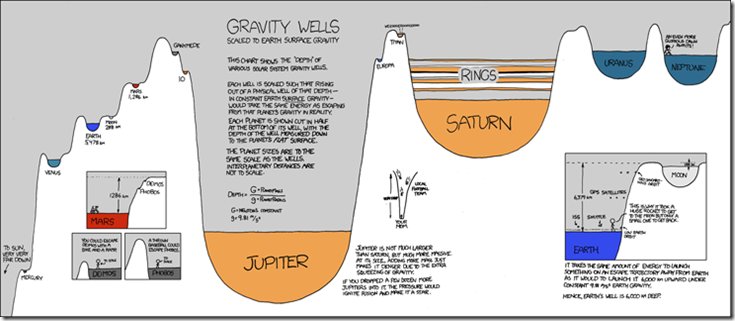
There are some interesting features that can be useful to explain to challenges of space habitation.
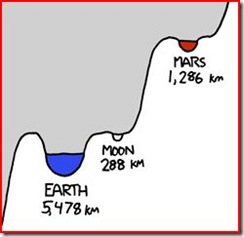
The above picture contradicts a lot of the literature I’ve read on space habitation. A lot of works say that the Earth’s gravity is the only major road block to being a fully spacefaring species. This graph, however, places the sun’s gravity as the major obstacle to accessing the resources of Mars. Escaping Earth only places a space craft 1/3 energetically to Mars. Moving from Earth to an orbit around Jupiter will be even more energy intensive. Making it seem that a Moon colony would be more efficient then a Mars colony.
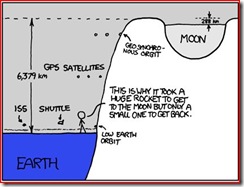
However, the sun has one benefit. The sun’s gravity well will allow for easy transport back to Earth from our habitations. Rare materials will be cheaper to bring back to Earth, ignoring the whole atmospheric reentry thing.
The above picture is support for orbital space colonies. An orbital colony does not have to escape a planet body twice. They only have to deal with getting their passengers and supplies to orbit. Plus, going to orbit is cheaper energetically then leaving Earth orbit.
-The idea of a Venus habitation have been tossed around for a while, does the acceleration by the sun’s gravity make the risks worth it?

There are some interesting features that can be useful to explain to challenges of space habitation.

The above picture contradicts a lot of the literature I’ve read on space habitation. A lot of works say that the Earth’s gravity is the only major road block to being a fully spacefaring species. This graph, however, places the sun’s gravity as the major obstacle to accessing the resources of Mars. Escaping Earth only places a space craft 1/3 energetically to Mars. Moving from Earth to an orbit around Jupiter will be even more energy intensive. Making it seem that a Moon colony would be more efficient then a Mars colony.

However, the sun has one benefit. The sun’s gravity well will allow for easy transport back to Earth from our habitations. Rare materials will be cheaper to bring back to Earth, ignoring the whole atmospheric reentry thing.
The above picture is support for orbital space colonies. An orbital colony does not have to escape a planet body twice. They only have to deal with getting their passengers and supplies to orbit. Plus, going to orbit is cheaper energetically then leaving Earth orbit.
Reactions
-This model disregards anything that could reduce the effect of each plant’s gravity well (orbital motion, for example), do you still fell this is a decent way to look at the gravity wells in our solar system?-The idea of a Venus habitation have been tossed around for a while, does the acceleration by the sun’s gravity make the risks worth it?
Resources
Image Source: Munroe, Randall. “Gravity Wells.” XKCD. n.d. Web. Accessed 31 December, 2009. <http://xkcd.com/681/>In Case You Skimmed
- The sun’s gravity will add onto the energy needs to leave a planet’s surface.

Subscribe to:
Posts (Atom)
