Showing posts with label Astrosociology. Show all posts

Monday, May 24, 2010

Space Settlement, American Exceptionalism and the Fear Behind the ITAR

This is another essay I wrote during University Writing, enjoy!

Space Colonization is an attempt to solve the problems humanity now faces. Garard K. O'Neill, space settlement expert and founder of the Space Studies Institute based his book, which now stands as the flagship argument for space habitation, in the previous idea. While considering the past violations and plunders by highly developed countries, O'Neill claimed that “[i]t is unlikely...that a large segment of the population in the advanced countries is going to reduce its standard of living by a substantial amount, voluntarily, in order to share the wealth of Earth with emerging nations. [But, there is] a way in which inexpensive, inexhaustible energy sources can be made available to the developing nations without [requiring] self-denial” (O'Neill, 16). O'Neill was troubled at thought that there where “areas of our world where the problems are most severe, almost no one can spare the effort to think beyond the next meal” (O'Neill, 24). He worried that “most people lived out their lives in heavy labor, many as slaves” (O'Neill, 15). He realized, after reading the work of Professor Robert Heilbroner who “studied the consequences...for human political and social development” when resources are dwindling, that on a draining Earth “even in the decades immediately ahead we will be forced to turn to increasingly authoritarian governments” (O'Neill,20-21). The static state that humanity would need to continue with Earth as it only home would be “forced[,] in self-defense[,] to suppress new ideas” and would eliminate “the freedom to order one's life as one pleases” (O'Neill, 22). At its heart, that's what space settlement, as with any scientific challenge, is, an attempt to further and protect the four freedoms. If we stay on Earth, our resources will dwindle. The chaos generated by lack of water will be orders of magnitude greater then the struggle over oil. We will increasingly live in fear as nations seek to invade each other for the necessities of life, not even what is required for human comfort, we will go to war over survival. The freedom to speech and religion will be threatened as dictators rise in a draining Earth.

However, we can't blast off into space, not as a united species. Very few countries have space programs or even the technical expertise to begin one. Still more nations do not have the resources to feed their people. As O'Neill pointed out, the United States has an obligation to ensure that 3rd world countries can enjoy the freedom granted by becoming a space faring nation. However, since the poorer nations do not have the capacity to utilize space, the age of space colonization will bring with it the same challenges and dilemmas, in regards to foreign policy, that faced the United States before it's involvement with World War Two.

When president Franklin D. Roosevelt gave his pre-Pearl Harbor address The Four Freedoms, he was seeking support for the Lend-Lease Act. He wanted the Unites States congress to aid other democratic nations in the protection of the Four Freedoms, which Roosevelt proclaimed were freedom of speech, freedom of religion, freedom from want and freedom from fear. The US congress needed to be convinced because they were still holding onto the ideas of isolationism. Because of this ideology, the US would not participate or give arms to nations struggling to deal with the Nazi threat. However, just like how nations were not prepared to deal with the Nazi threat, many nations of today are not prepared to compete in a space faring economy.

It would seem the US would aid in the technological advancement of these nations since the address by Roosevelt has been incorporated into our myths; his speech informs our decisions and should inform our actions as a nation active in space. It would seem that Roosevelt, whose word's are now incorporated in the culture of the United States, would ask us to remember “that the safety of our country and of democracy are overwhelmingly involved in events far beyond our borders” (Roosevelt, 2). It was these freedoms which O'Neill and his supporters sought to protect and secure for ourselves and other nations through the multinational settlement of space. However, this idea is not fully reflected in this nation's laws, especially those regarding space.

The International Trade Arms Regulations or ITAR is a Cold War era export control law which limits the sharing of technical information to foreign countries. The major effect of this law in the space community is that no one, even our allies, can discuss technical specifications with US space technology producers. Imagine buying a car without knowing whether or not it had power steering, just knowing that the car turned. It is designed to ensure that our technology is the best by making sure our technological advancements remain in the country. From this nation's perspective, the law is great, but a more global perspective gives a different idea.

Scientist and advisor to the French space program, Jacques Blamont, commenting on the ITAR in his paper International Space Exploration: Cooperative or Competitive said “it is difficult to believe that a large-scale endeavor, which would require technical exchanges on many subjects where American superiority is overwhelming, could be successfully carried out on a day-to-day basis” in the current political environment (Blamont, 91). In effect, our isolation has frozen any possibilities for a large scale space project, such as space habitation. This freeze of international cooperation is demonstrated when we read about Blamont's horror to hear NASA employees exclaim “[i]t is unthinkable that equipment developed in a Federal Center might be used by a foreign agency” (Blamont, 91). Because of experiences like this, he felt that, because of the ITAR and the culture it promotes, there was a “suspicious atmosphere in the USA towards foreign relations” (Blamont, 91). Thus, ITAR is isolationism in space and this isolation has a negative effect.

This self serving isolation is not conductive to a peaceful future nor is it realistic in the vastness of space. Blamont pointed out that “[m]any in Europe believe that it is not a wise choice for [Europeans] to place any long-term strategic trust in the USA” (Blamont, 91).The US has, in the perspective of Blamont and many other Europeans, “shown...a disregard for anyone's interests but its own” , alienating all other nations (Blamont, 91). We are attempting to go forth into infinite nothing by ourselves and we are making enemies in the process.

Is this the correct direction for the United States? Maybe in the past, but the president of the American Historical Association and champion of the idea that American freedom was changed through its interactions with different types of freedoms, oppression and slavery, Eric Foner, would disagree. Foner claimed that the idea of freedom was challenged and modified because “the world we inhabit is getting smaller and more integrated and that formally autonomous nations are bound ever more by a complex web of economic and cultural connections” (Foner, 51). Our international activities have “helped to establish how freedom is understood within the United States” (Foner, 58). We are an international culture already, we have been effected already and we have modified our self image based on observations of other countries. We are, in effect, a product of globalization; what informs our ideals now is not internal.

But this web does not only challenge freedom, it creates a highway where every event or development interacts with other occurrences. Some would argue that a technical edge will ensure our rank on the world power ladder, but the truth is, our technological development is felt everywhere and we feel other countries technical development. We improve Japanese technology by having our developments, in the form of components, create a foundation for new developments. The United States bases our developments on foreign components too. Space activity is further complicated by the International Space Station. We bring up the equipment for Russian experiments and supplies, they bring up food and other parts. The question is are we willing to give up this peaceful cooperation with countries we dropped or threatened to drop nuclear bombs on for a technological edge? Are we willing subordinate other countries, like “Russia [who is not in fact] a cooperative partner, but a subcontractor” for the so called International Space Station (Blamont, 91).

Nussbaum is an American philosopher who wrote a paper exploring the ethical problems encountered when dealing with the problems of globalization. Her paper is of interest when studying the ITAR because of her discussion on American exceptionalism and the fear the drives us to isolate ourselves. She is frank when she points out that “compassion for our fellow Americans can all too easily slip over into a desire to make America out on top and to subordinate other nations” (Nussbaum, 13). In short, she struggles with how to control our compassion for international good.

The isolation imposed by the ITAR and the fear of technical disadvantage brings to mind the ideas discussed in Nussbaum's Compassion & Terror. The blind terror that made American spines tingle after hearing the radio transmission from the Sputnik spawned the ITAR. America was fearful because the Sputnik proved the USSR had the ability to drop a nuclear bomb anywhere when Americas did not have this ability. The USSR had a huge bargaining chip because the USSR managed to upset the balance that was the stalemate between the US and the USSR. The terror of being at a technical disadvantage and having one's military rendered obsolete with one development “could be a stimulus for blind rage and aggression against all the opposi[ng]” nations (Nussbaum, 26). In this environment of fear, the sharing of technical data becomes traitorous, on par with handing over a nation's fleet to its enemy. However, this is blind rage against all nations, an attempt to limit the scientific development of the targeted nation, just to eliminate all possibilities of technical disadvantage. It isolates nations from the scientific community whose insights who be enhanced with other perspectives.

To avoid permanent tension and stress, instead of joy, at every technical advance “we [need to do what Nussbaum suggests and] cultivate a culture of critical compassion...awaken a larger sense of the humanity of suffering, a patriotism constrained by respect for human dignity and by a vivid sense of the real losses and needs of other people” (Nussbaum, 26). Space is a common dream for not only this nation, but for all nations in the world. Everyday we are not space faring is a tragedy for all humans because it is a day we are not utilizing the resources of space. It is one more day we fail to find a permanent and reasonable solution to our energy needs. Not to mention the delaying of cancer treatments, the cure for AIDS, the solution to world hunger and other problems that could be tackled by a united, global scientific community even without the use of space.

Simply worded by President Roosevelt, there are “basic things expected by our people of their political and economic systems”. The lack of these basic needs, jobs, food, opportunity, increasing standards of living and freedom is “the root cause of... social revolution” good or bad. In a world where people are dying of lack, there will be, as predicted by Roosevelt in his speech, “[t]hose who would give up essential liberty to purchase a little temporary safety”. Thus, the long term goal of the acquisition and use of the resources in space is an attempt to protect freedom because it is an attempt to ensure these basic needs are met. Anything that slows down progress towards the goal of becoming a space faring species is a threat to freedom. American selfishness is one of those roadblocks.

However, international, globalized efforts bring their own problems which we must deal with before moving as species into space. Currently, we are dealing with the death of cultures, sweatshops, increased economic disparity and other social ills brought on by globalization. But why does this matter? Are we not heading into an age of infinite resources, a rebirth of humanity where all our problems will melt with each rocket launch?

The paper The Ethical Commercialization of Outer Space by Dr. David M. Livingston explains why the current state of the world will indicate the how the first stages, and all subsequent stages, of space habitation will look. The paper continues to show the rhetoric and ethic-less thought surrounding the colonial period that is mirrored in the space community with quotes from leaders in the space field. After reviewing the troubling state of the space community, Livingston considers the following quote from “Paul L. Csonka['s]... 'Space Colonization—Yes, But Not Now':

'If space colonization were to be undertaken today at the maximum rate permitted by technology, it is likely that instead of increasing the chances of human survival, it would drastically reduce it. Preliminary studies ought to be undertaken, but large scale colonization should be postponed until such a time when (and if) social and political conditions reach the prerequisite state of sophistication'”(Livingston, 3).

This paints the obstacles to space settlement not as engineering problems, but as social and ethical problems. The social and ethic problems are of increased concern when we release that “initially our voyage to space and the first phases of our expanded space commerce will resemble the business and management models that are exported from Earth”(Livingston, 2). That statement should strike fear in the hearts of humans because it means we will end up fighting over the nearly infinite energy produced by the sun, we will kill despite the plenty that exists in space. The fight will start because we will ignore the plenty and quibble over our share, always ensuring that we have some type of edge, just like we do now as demonstrated by the ITAR.

Csonka's idea is also highlighted by our history as presented in Foner's work, American Freedom in A Global Age. To Americans, as Foner explains when exploring the myths around freedom, “territorial growth meant 'extending the area of freedom...' [.] Those who stood in the way...were by definition obstacles to the progress of liberty. In the outlook of most white Americans, the West was not a battleground of peoples and governments but an 'empty' space ready to be occupied as part of the divine mission of the United States” (Foner, 61). This idea is now part of our myths. When, not if, we look at these myths to inform our choices on how to go forth into this vast nothingness, these stories will be with us. There are also other nations with their own stores of the glory of planting a flag or stories of how it is useless to plant a flag. Their myths of conquering other lands or the founding of their nation will inform their decisions on the use of space. These myths could easily lead to war.

Even attempting to discuss our international efforts in space will bring chaos since each participant's self view will conflict. This is best understood by Devdutt Pattanaik, the Chief Belief Officer at Future Group in Mumbai, whose job is to help companies interact with customers in foreign environments. Through his work, he has concluded that most nations think that “[their] world [view] is always better than [the foreign view], because [their] world [view]...is[, in their minds,] rational and [foreign views are] superstition...”(Pattanaik, 1) . “This is the root of the clash of civilizations” (Pattanaik, 1). This will cause war once we are able to access space because each nation's myths are going to conflict.

At first glance it seems that war will always be it the cards for us, however, it is possible that space it self eliminates the problems of our modern world. People who travel to space experience something called the overview effect. Saudi-Arabian Prince Sultan Bin Salman al-Saud described this as “an opportunity to prove that there is no conflict...Looking at it from here, the troubles all over the world, and not just the Middle East, look very strange as you see the boundaries and border lines disappearing” (Livingston, 7). Once the borders are gone, our compassion for our homeland bleeds into compassion for a land on the other side of the globe. Without boarders, our narcissism becomes silly and we will no longer look for some form of an edge because of the overview effect.

Narcissism will dissolve because the overview effect may be the answer to the problem of death within life presented in Nussbaum's work. This particular problem came up in her paper when she attempted to solve the social issue of the sweatshop by asking “all [people] to care equally for all other [people]”. This doesn't work in the modern day because the only reason that makes people “care for something [is] the though that it is all theirs...and the thought that it is the only one they have”. This is why it is very hard to have people care for others jointly. However, the thought that we live on a fragile planet will instill the idea that the Earth and all life on it is all ours and it is the only place we have. Astronomer and science advocate Carl Segan explains...

The Earth is a very small stage in a vast cosmic arena. Think of the rivers of blood spilled by all those generals and emperors so that, in glory and triumph, they could become the momentary masters of a fraction of a dot....Our posturings, our imagined self-importance, the delusion that we have some privileged position in the Universe, are challenged by this point of pale light...[thus, t]here is perhaps no better demonstration of the folly of human conceits than this distant image of our tiny world. ...[The pale blue dot] underscores our responsibility to deal more kindly with one another...(Segan, 7-8)

This is furthered by Dr. Livingston's point “the heavens are already taken and they are not our home” (Livingston, 9). This is the only place where we can live without millions of dollars of delicate, sensitive equipment and we can only visit space with our current technology. Our astronauts, over time, lose muscle function and bone mass and must retreat to this rare paradise we live on. We have yet to master the problems of cosmic radiation, forcing us to stand behind the magnetic shield formed by the Earth. Yet, we are concerned about a technical edge on something so insignificant. Something whose light is made obscure by the light from the billions of stars in our galaxy which is indistinguishable from the billions of galaxy. Something that doesn't matter in the pure, infinity nothingness that separates each planet, each star and each galaxy. It seems we are willing to destroy this life giving pale blue dot in lust for the none substantive things such as financial, technological and social power.

Furthermore, space may interact with the American myths in the same way that Foner thought freedom interacted with outside events. “American's relationship to the outside world... help[ed] to establish how freedom is understood within the United States” (Foner, 58). Just as the “struggle against Nazi tyranny and its theory of a master race discredited ideas of inborn ethnic”, experiencing the limits of our technology and our bodies may humble this nation (Foner, 66-67). If we realize what Prince Sultan Bin Salman al-Saud realized, will we end up pledging allegiance not to the American flag, but to a flag of humanity. Will we change vastly when American exceptionalism, “the delusion that we have some privileged position in the Universe, [is] challenged by [a] point of pale light” (Segan, 8).


Works Cited

The Ethical Commercialization of Outer Space. David M. Livingston, ASCE Conf. Proc. 204, 16 (2000), DOI:10.1061/40479(204)16

Nussbaum, Martha C. “Compassion and Terror.” Daedalus. 132 (Winter 2003): 10-26. (On UWP list: 06-07; 07-08)

Foner, Eric. “American Freedom in a Global Age.” Who Owns History? Rethinking the Past in a Changing World. New York: Hill and Want, 2002. 49-74

Roosevelt, Franklin Delano. "The Four Freedoms." American Rhetoric. N.p., n.d.. Web. 9 Apr 2010. <http://www.americanrhetoric.com/speeches/fdrthefourfreedoms.htm>.

Segan, Carl. Pale Blue Dot. New York: Random House, 1997. Print.

Pattanaik, Devdutt. "East vs. West -- the myths that mystify" November 2009. Online video clip. TED. Accessed on 12 March 2010.

Jacques Blamont, International space exploration: Cooperative or competitive?, Space Policy, Volume 21, Issue 2, May 2005, Pages 89-92, ISSN 0265-9646, DOI: 10.1016/j.spacepol.2005.03.003

ITAR photo by http://www.pennwellblogs.com/

Thursday, February 4, 2010

CAT: Political Cycles

Welcome to Counter Argument Thursday (CAT). This is where I write blog post the is opposite and critical of my position on space habitation and space habitation. I do not agree with the position in the blog post, but it is an argument I need to address.

Space habitation is a dream that cannot survival the vicious political cycles in modern government structures, just like every plan that takes multiple generations. space habitation will take at least two generations. Even a moon base takes 30 years to build, as claimed in the paper Lunar Industries and Their Value for the Human Environment on Earth. I can’t even claim there will be long term political stability in a totalitarian state, they too have political cycles.  In fact, unless a long term goal in woven into the social fabric of a nation, it won’t get done. Furthermore, to be blunt, space is far from being woven into the social fabric of, at least, the United States. I offer the Rasmussen Reports article 50% Favor Cutting Back on Space Exploration as proof. If a moon landing can’t make space into a social goal, nothing can. Thus, there will be progress toward space habitation while it is politically favorable and that progress will be halted when the tides turn.

In Case You Skimmed

-Space habitation is a long term goal the requires political stability.

-Political stability simply doesn’t exist

Reactions

-Could an international organization offer the political stability needed to space habitation?

-Could space habitation research hibernate in academia during politically rough times, only to reemerge better then ever when the public is ready?

-Will there be funding for space habitation in academia during politically rough times?

-Will there be a student interest in space habitation during politically rough times?

Resources

Krafft A. Ehricke, Lunar industries and their value for the human environment on Earth, Acta Astronautica, Volume 1, Issues 5-6, May-June 1974, Pages 585-622, ISSN 0094-5765, DOI: 10.1016/0094-5765(74)90023-X. (http://www.sciencedirect.com/science/article/B6V1N-4805SJ8-5/2/4d9bdc1efb4a1a033b97f934b0fe09e8)

Rasmussen Reports, “50% Favor Cutting Back on Space Exploration” Weblog entry. Rasmussen Reports. January 15, 2010. January 18, 2010 <http://www.rasmussenreports.com/public_content/lifestyle/general_lifestyle/

january_2010/50_favor_cutting_back_on_space_exploration>


Thursday, January 7, 2010

Counter Argument Thursday: We Cannot Protect Space

Welcome to Counter Argument Thursday. This is where I write blog post the is opposite and critical of my position on space habitation and space habitation. I do not agree with the position in the blog post, but it is an argument I need to address.

People will not be careful in the way they use space. Space is lifeless, but the Earth, which is unique with its ability to support life, is not respected. Forget recycling, people will not put stuff in designated landfills which are sealed against leaking and somewhat environmentally friendly. Parks and uninhabited areas on Earth often turn into dumping yards. Illegal dumping area are not sealed and the waste will leak into drinking water. Trash is dumped into the sea, we even have the Great Pacific Ocean Garbage Patch. People do not recycle Aluminum, the holy grail of recyclables. How on Earth do you expect people to be green in space when there is not environment to protect.

The orbital debris argument is valid, but if we land on a plant, why should I care about the trash I leave behind. If there is a piece of failed equipment that cannot be serviced, why bother bringing it back to Earth. The waste will be organized and contained in a safe way, but I am not hauling my waste back to Earth. I can dump fuel in space if I need to without any short term dangers.

Look, space is about survival. Space is a harsh environment. Survival has a priority over conservation, the short term will always win over the long term in space. Thus, we cannot protect space. Combined with a lack of a market force to protect space, it cannot be done.

Reactions

-How do we develop a market force to convince people to protect space?

-Could legislation work?

In Case You Skimmed

  • There is not enough market force or reason to force people to be considerate in their actions in space.

Creative Commons License

Saturday, January 2, 2010

10 Commandments of Space Habitation

This commandments are complete idealism. However, I feel that breaking these rules will lead humanity down a path to because a species that commits atrocities to other life forms and a species at never ending war. I’m just tossing some ideas out on the table, feel free to debate and challenge these commandments. Remember, I’m not a god.

10 Commandments of Space Habitation

Photo by tommrkr

1: Thou shall not inhabit another planetary body that has macroscopic life.

This commandment is meant to stop all the atrocities of the colonial period. I excluded microscopic life because it is too hard to detect from orbit, but microscopic life should be handled cautiously because of the health risks. However, microscopic life can be considered macroscopic if they are visible in clusters. Basically, if we can see a life form from orbit, we can’t inhabit that planet.

Then there is the whole ethics thing, but I could write a book about that.

This commandment only applies to macroscopic life we did not put on the surface.

2: Thou shall not send out a spaceship with enough arms for over 1% of the occupants.

This commandment is included to prevent interstellar warfare. An interplanetary war would be far more costly in lives then any other war we have fought, plus, we risk losing both warring biospheres. However, weapons will be needed for security forces on a space habitation, mainly because amoral people will smuggle weapons to a space settlement. So, those at customs stations will have to be armed and police will have to be armed to protect themselves and others.

3: Thou shall not leave anything that isn’t working in space.

We messed up Earth’s orbit, let’s not do it again. Please. And please don’t create interplanetary space junk. That would be a nightmare to deal with.

4: Thou shall not take more then 5% of the freshwater on any planetary body into space.

Crews will need water to get from one body to another, however, I fear that a huge fleets of spaceships will extract too much water from Earth and other planets for supplies while in transit. I think water should be “on loan” from the main planet. For example, if we had a commuter level of traffic between Earth and Mars, ships would pickup water for the voyage at an orbital station and drop off the water at another station at the end of the voyage, where another ship could use that water. This will take intense water recycling system, but it will protect the water resources we do find and allow of communities to flourish where ever we find water.

Now, water can be made into fuel, but I think this fuel should only be made from undrinkable water. For example, salt water on Earth and water that is contaminated on the moon. In other words, if all that is needed to make the water drinkable is a simple filter and an anti-bacterial agent, then it should be valued to not taken in excess from a planetary body.

5: Thou shall not bar people from joining the space settlement  mission because of race, religion, sex and sexual orientation.

When I read about the Neo-Nazi Mars base initiative, shivers went down my spine. The racial tension between such a colony and the rest of humanity is enough to spark war.

Of course, religious organizations will want their own settlements, but I do not think people will necessary skills should be barred from a mission. To do that would endanger the mission. I think becoming a spacefaring species will allow us to be a more companionate species and be tolerant of each other.

6: Thou shall not populate another life supporting system or system that is capable of supporting life at the expense of another.

This commandment prevents us from becoming an interstellar fire, consuming everything in our path. I do not feel that hoping from planet to planet, exploiting the resources on each planet is a sustainable way from a species to operate. Following this commandment will also ensure we are creating biosphere backups.

However, Near Earth Objects(NEOs) and other places that can not be terraformed are fair game, so long as those resources are used responsibly (As explained in the next few commandments). However, we can not strip mine Mars because it can support life with a few modifications. Thus, an planetary object that should be respected is an object with enough mass to have an atmosphere.

7: Thou shall not use more than .01% of the resources in a solar system per year with respect to 2010.

This commandment assumes we will not achieve faster the light travel. If this assumption is true, then this solar system will be the only one we inhabit for a while. This commandment ensures a sustainable lifestyle, one that guarantees we can live in a solar system for a minimum of 10,000 years. Long enough to prepare for a mass migration or replenishment of resources. I’ve also noticed that in an age a plenty, we will toss things away, but when we do not have much, we will recycle. This commandment will force use to recycle resources we find to prevent us from reaching the maximum because the abundance of resources while be put into perspective.

8: Thou shall not use more than .01% of the resources on a planetary body per year with respect to 2010

This rule budgets the use of Each planet’s, object’s and moon’s resources so that a civilization using those resources will be able to tap into those resources for 10,000 years. Long enough to make the investment worth while.

9: Thou shall not make or accept an unbalanced trade with another space settlement.

The goal of this is to prevent a space settlement from just being a mining outpost, one that is abandoned as soon as the resources are gone. In other words, the best way to use space is to inhabit it, not strip it. Balanced trade is that best way to do this. Trading one resource for another will allow communities to fix its weakens by using its strengths. If done correctly, when the resources that attracted people to the site in the first place are gone, a vibrant community the can support its self will still remain. 

10: Thou shall not equip a spaceship with weapons that can penetrate the hull of a standard spaceship

Spaceships are basically tin cans with 1 atmosphere is pressure pushing out. A hole in the ship will cause a significant loss of air. Yes, we can build bulk heads for seal off damaged areas, but the crew has to react within seconds, while under fire, to prevent the whole spaceship from depressurizing. In this light, I consider any weapon that can penetrate the hull of a spacecraft a weapon of mass destruction because one shot has the potential to kill 1000s of people if fired at a larger spacecraft.

However, non-penetrating weapons are the non-lethal weaponry of interstellar combat. One can target weapon ports, communications arrays, solar panels and engines to get an aggressor to stop. I would suggest EMP weaponry, but it would destroy life support systems and most circuitry in space is hardened, so that they of weaponry is ineffective.

Note: this commandment assumes people will install some type of armor to protect against the many fast moving rocks and junk floating in space.

Reactions

-Do I cover everything?

-Will these rules be useful in the real world, remember, these rules are complete idealism?

-Will following these rules place humanity in harm’s way?

-Would you rewrite this rules if you where director of space habitation?

In Case You Skimmed

  • We should settle space in a sustainable way
  • We should learn from our mistakes on Earth

Creative Commons License

Monday, December 28, 2009

An Unwanted Change

The Future of Work article titled Compass: Back to Basics:  Change Banagement 101 brought up a good point:

“people don't universally resist change; what they resist, and resent, is being changed, with no control over where, when, or how that change is imposed on them. People don't demand stability—what most of us want is predictability, or at least a reasonable level of personal control over whatever changes they are subjected to.”

This causes a problem for space habitation. We don’t know how space habitation will affect society. People will feel like they can not control the societal changes brought by space habitation. We already see this resistance manifested in the culture wars. Space habitation will see similar resistance because they are forced to change for space habitation. A space faring culture will demand more education; it will demand more skills. New professions will be formed and professions will die because of the increased technology. This will cause people to fight against space habitation.

Reactions

-How do we prevent a war against space habitation?

Resources

Ware, Jim. Charlie Grantham, “Compass: Back to Basics:  Change Banagement 101. Weblog entry. The Future of Work. 10/22/2007. Accessed 12/28/2009 <http://www.thefutureofwork.net/newsletter_1209_Compass.html>

via

Smith, Stephen, “Thinking about Change.” Weblog entry. …words. 12/26/2009. Accessed 12/28/2009 <http://stephenpsmith.com/blog/2009/12/thinking-about-change/>

In Case You Skimmed

  • Space habitation will be resisted because it will change society.

Creative Commons License

Sunday, September 13, 2009

SPC #14: The Cultural Imperative to Colonize Space: An Astrosociological Perspective

Welcome to the Sunday Paper Club. (Almost) every Sunday, this blog will offer analysis of a paper on space habitation and other related topics. These are my opinions on a weekly scientific paper; basically I read the paper and write down my thoughts are I read it. They are subject to my perspectives and believes. I am open to debate, so if any reader believes I have misinterpreted something in a paper, please point it out. I'm only a student and I'm still learning how to read these papers and interpret them. All quotes are from the paper unless otherwise noted. All papers I review are available for free online.

This week we are reviewing The Cultural Imperative to Colonize Space:An Astrosociological Perspective.

The paper’s first main point is how humans are drawn to space more then the bottom of the oceans. This is due mainly to the culture defining aspect of space. I urge you to look at table 1 on page 4. As you will see, the way we viewed, for example, Mars effected the way society operated.

The main point of the paper is to point out how space habitation is needed to sustain the way that humans live. But, while reading this paper, I was reminded of this quote in The Matrix

I'd like to share a revelation that I’ve had during my time here. It came to me when I tried to classify your species, and I realized that humans are not actually mammals. Every mammal on this planet instinctively develops a natural equilibrium with the surrounding environment; but you humans do not. Instead you multiply, and multiply, until every resource is consumed. The only way for you to survive is to spread to another area. There is another organism on this planet that follows the same pattern... a virus. Human beings are a disease, a cancer on this planet, you are a plague, and we... are the cure.

The whole point of this paper is null and void if humans are able to change they way they live. A simple change in mind set, from a short term one to a long term one, could be enough to save humanity. It might even be so much that space habitation is not needed. The question is “can humans develop a natural equilibrium”? We also must learn how to not waste opportunities.

Manned space flight is like the wheel, it is game changing. It will completely redefine everything about human life. But “The Aztecs… had the wheel, but only used it in the construction of toys and in their calendars. There is
likely an assortment of mundane explanations for the failure of the wheel to diffuse across other sectors of Aztec
society”. The critical part of that quote is contained in two words “mundane explanations” (Read: the day-to-day actions of the members of Aztec society). It is nothing more then that. Nothing more prevented the Aztecs from saving themselves from collapse. They had a huge advantage.

Why does that sound so familiar…

I remember, humanity’s space activity is a mix between a recruitment ad for scientists and engineers and a power grab by the leaders of various nations.  Yes, we need more scientists and engineers, but that is an inherent quality about all space activity. We can move on to bigger, betting things and use the ground breaking technology to change the game.

Last, but not least, the paper suggests a vast increase in education funding. But, the only way we can get the money is if we over come the vast anti-intellectualism in the world.

Reactions

-Can humans become less virus like?

In Case You Skimmed

-If human society remains the same, then we need space habitation.


Creative Commons License

Thursday, August 6, 2009

Defining Success in the Space Faring Society

In Alain de Botton's TED (Technology, Entertainment, Design) talk, titled A Kinder, Gentler Philosophy of Success, Alain de Botton points out the link between our views on success and how we feel about ourselves. He tells us in his talk why a meritocratic society forgets about the randomness of success. I think the space faring society will have an even more extreme version of meritocracy then today. Assuming the interstellar spaceship is the symbol of a space faring society, then that society will think that anyone can do anything. Think of the ideal spaceship; the spaceship of Star Trek. This spaceship is very defiant, it overcomes gravity and thumbs its nose at the laws of physics with its warp drive. The radiation that keep man from exploring space is laughed at with its energy shields. Nothing can stop an ideal spaceship.

619307160_019d96a443_b

If the spaceships of the space faring society influence the development of that society, then we might have a problem. If the society is influenced by the spaceship then we might see bigger expectation that one is successful, far greater then what is seen today. Simply because the ideal spaceship has nothing stopping it from achieving greatness; only poor maintenance or a poor crew can stop it. This might cause the society to think nothing stops a person from success except for personal weakness. I'm speculating with this post, but I'm really curious about how a space faring society will think about success.

Reactions

-Will a space faring society have an extreme view on success?

Resources

Photo by aloshbennett

Botton, Alain de. "A Kinder, Gentler Philosophy of Success" July 2009. Online video clip. TED. Accessed on August 06, 2009. <http://www.ted.com/talks/alain_de_botton_a_kinder_gentler_philosophy_of_success.html>

In Case You Skimmed

  • The characteristics spaceship with be reflected in the believes of a society
  • A space faring society, because a spaceship can easily overcome obstacles, might think that everyone can overcome their obstacles  

Creative Commons License

Sunday, August 2, 2009

SPC #11: Applications of Living Systems Theory of Life in Space

Welcome to the Sunday Paper Club. Every Sunday, this blog will offer analysis of a paper on space habitation and other related topics. These are my opinions on a weekly scientific paper; basically I read the paper and write down my thoughts are I read it. They are subject to my perspectives and believes. I am open to debate, so if any reader believes I have misinterpreted something in a paper, please point it out. I'm only a student and I'm still learning how to read these papers and interpret them. All quotes are from the paper unless otherwise noted. All papers I review are available for free online.

This week we are reviewing the paper Applications of Living Systems Theory of Life in Space.

Since some humans will be spending more and more time in space, we need to think of the human factor more then ever. So far, astronauts have been able to endure the stressful environment of space because the astronauts were able to build up enough motivation to cope with the stress. But, as people are subjected to small living spaces and a lack of privacy, they may burnout or snap. As we move farther from Earth, feeling of isolation from humanity will grow.

If we use living systems theory, it could solve the problem that come with the human factor. Living systems theory is the combined study of technology, sociology, biology and ecology. Of course, this brings a problem, the sciences are compartmented. So, we must reinvent our education system to give people a general sense of how their systems effect other factors because we need to study every aspect of space habitation in order for it to work.

Living systems theory is to categorize the subsystems of non-biological systems into twenty categories and identify the amount of inputs for the system to work based on the categorizes of subsystems in biological systems. Once we know this, we can fix dysfunctional systems. The 20 subsystems are: the reproducer, the boundary, the ingestor, the distributor, the converter, the producer, matter-energy storage systems, the extruder, the motor, the supporter, the output transducer, the encoder, the decider, memory, the associator, the decoder, the timer, the channel and net, and the internal transducer.

The study has a very interesting diagram on page 25 of the PDF which maps every part of a moon base to the 20 subsystems. It really shows how complicated even the simplest moon base would be.

Basically, NASA is using living systems theory to make sure every possibility is planned for. If every subsystem is strong, then the whole system could stand up to a lot.

Reactions

- Is it a good idea to low at what we need for space habitation in terms of what our body needs to function?

In Case You Skimmed

-Biological systems have 20 subsystems

-In order for a space habitat to function well, it must replicate biological systems with its own version of the 20 subsystems

Creative Commons License

Thursday, July 23, 2009

Our Education System May Be Blocking Space Habitation

Now, I want to be very clear, a highly educated society is needed for space habitation. But, I think our high schools destroys important qualities of human beings that provides the emotional motivation behind space habitation. It destroys the morality of students and morality is required in the space field because shady operations who value profit over human life will not survive in space; space will find the flaws in anything and use that flaw to rip apart the mission. Our education system is not about education, but crystallization. Students are unwilling to think outside of the box, because if you stay in the box, you are guaranteed an A.

I wrote this essay for my final writing task of high school. We had to argue against one educational philosophy then create our own...

A school with passion for space

The degree is like Ithaca, but the journey to earn a degree has changed greatly. A college degree is not a symbol of years of honing and patient meditation on a field, it has become a symbol of a fast track to the upper-middle class. Students' “thoughts [do not] remain lofty [and]... a fine emotion [does not] touch their bod[ies]”1. Students rush to take AP classes so they may earn credits to graduate from college a year early. Students expect a degree to bring them riches, only to come out of college passionless and doomed to mediocrity. Arriving at Ithaca does not make a man great. What makes a man great is the lessons learned from the road and a passion for life. However, in the modern day, this slow foot journey has been replaced with a bullet train, nonstop from childhood to Ithaca. But, something is lost in the most recent generation. Students do not have a reason to want to go to Ithaca and the slow journey the builds an understanding of what Ithaca, what a degree is, has been lost. Students are just placed on the train by parents who want their children to experience Ithaca, but do not when them to experience the hardships that make makes Ithaca a great place. Students will continue to have their humanity torn from them if we do not demolish those rail lines.


High schools still have a utilitarian mindset despite administrators' ongoing effort to make high schools creative. This has nothing to do with how the teacher conducts his lessons, the goals of the administration, or the intentions of the community; for no parent or teacher wants to crush the spirit of a child. It is due to the culture that has arisen around schools that encourages students to approach school with a utilitarian perspective. The ideal student of top schools like Whitney High School or Princeton High School is the student with a 4.0 GPA, a 2400 SAT score, and 36 ACT score. This ideal student is praised and lusted after so much that "confused kid[s have] parent[s who] t[ell them] it [is] okay to cheat if [they] earned an A, because [their] future was at stake. Just don't get caught, [they] are warned" 2. This is reminiscent of Mr. Harthouse, one of the model utilitarians in Hard Times, who said "I am not a moral sort of fellow... and I never make any pretensions to the character of a moral sort of fellow. I am as immoral as need be" 3. It is as if the student were a machine, expected to give output without giving thought to aspects of humanity like morality or emotions and it is this utilitarian temperament that is creeping into our schools because of the over-reliance on grades.


The current high school system relies too much on grades. As a result the morale and the morality of the student are both negatively affected 4. Students cannot afford to fail (anything short of the model student is defined as failing) so they stick to topics that they are comfortable with and ideas which are already well proven. But, in the process they loss the joy of learning, the thrill of discovery and do not grow. Regurgitating information can guarantee an "A", and in a system where an "A" is next to godliness, that is what students will, unhappily, do. Uncertainty is required to keep the student interested and allow the student to grow5. Yet, uncertainty can bring a failed project, a failed writing risk, or a easily dismissed idea and to become like the model student, one can not fail, ever.


Furthermore, developing a strong moral fiber in the school is discouraged when grades are idealized. Not only in the sense of cheating, but in the sense of other acts where one's conscience must be the guide. Students who value grades alone (as opposed to self-improvement through learning) choose not to help others with their work; students who value grades alone will not look up from the textbook or even explore harder ideas 6. In the movie Smart People, Vanessa, a perfect example of today's model student, continues to study after learning her father is in the hospital with head trauma. Later, Vanessa is concerned not about her father's health, who has had his license revoked because of seizures, but is worried over her lack of transportation to the various resume padding extracurricular activities that have become a keystone in the passionless high school experience. Why should Vanessa or any student do anything but look at their books when they are members of a system which does not give rewards to the helpful, the empathic or the curious and which lavishes praise on the workaholic? Students who value grades alone do not learn to respect learning or life. They do not enjoy the rare experience that is life. They do not give the course material the time it needs to mold and shape a person or try to explore unmapped ideas.


In order to develop a passion for learning, the student must be pushed outside of his comfort zone. In search of the A, students would "rather accept an A in an easy class rather than fail a hard one and learn a great deal from it"7. The student who said this has lost the value of an education while remaining within his comfort zone. The most is learned when the student is challenged and occasionally fails. For example, a student can procrastinate in easy classes will never learn, until he enters the real world, that procrastination is a bad habit. Schools provide a unique environment where students can fail and learn from the failure without the disastrous consequences of the real world. This unique environment is squandered when students are too fearful to take risks; when student believe that everything they have worked for can be lost with each test or essay.

Thus over reliance on grades threatens the following traits which all students enter with: curiosity, the joy of learning, morality, happiness and passion; the on going search for the uncertainty and the trill of unmapped ideas; the certain quark and small gift that lights up a person when they are able to use it, the fulfillment the one searches for when they follow their dreams and the burning desire for growth. When these are lost, any hope of success is lost and mediocrity is ensured. Maybe William Farish did not intend for this to occur when he developed the letter grade system, but this incentive has created the opposite effect; students only want an A, they do not want to learn.

Tony Robbins, life couch and expert in leadership physiology, has said “I believe that the invisible force of internal drive, activated, is the most important thing in the world. I believe emotion is the force of life. All of us here have great minds... and with our minds we can rationalize anything. We can make anything happen”, but there are some people who have all the “education, money and background [they could ever want, but they] spend... their life going in and out of rehab” 8 9. Knowledge is power, but this can not power the soul. One needs something far more powerful then knowledge to achieve, one needs a purpose, a focus, a passion. The current philosophy of high schools not only fails to to promote this essential ingredient to the human experience, but crushes it. “Melissa Roderick, the professor at the School of Social Service Administration at the University of Chicago and co-director of the Consortium on Chicago School Research [speaking on college drop outs said] 'If you go into any urban high school right now and sit down with parents and kids and ask, 'What do you want to get out of high school?' there's only one answer: 'Graduate and go to college.'”10. This mentality is not limited to urban schools, across the world “graduate and go to college” has been the sole directive of all schools. While this objective should be held in high regard, it can not be the sole reason for the school to exist, which shall become the sole reason for the student to go to school; for the philosophy of the school is reflected in it's students. If it is the sole reason, there lacks an internal reason to graduate from high school and college. The student is simply told that he needs to graduate and go to college. This external reason is reinforced through fear of parents and fear of poverty. Those two reasons will not give the student the strength to complete college. For that, the student must realize himself that college is necessary for his goal in life. This is why schools must teach personal development. So that the students can find powerful reasons to support their actions. Once that happens, everything that student intents to do will be done. But, Tony Robbins also points out one more ingredient to success.

Emotional fitness must also be mastered by the student to be successful. If you where to take two job applicants from the same, elite college with the same grades and the same qualifications. It is a dead even tie between those two applicants. But, one applicant was completely unconfident, did not look the interviewer in the eye, was shaking like a dryer the whole time and seemed miserable. The other was confident, radiated passion and love for his work; he made everyone smile when he walked in the door and was full of seemingly endless energy. Who is getting the job? But this is not the only reason schools need to train students in emotional fitness. If the student falls in love, or lusts after someone or feels remorse for a past action, that student will be debilitated as these strong emotions rips through their body. If the student is not trained in emotions, that student will be overwhelmed. But, having complete control over one's emotions gives unstoppable power to that person. Sissy, in the novel Hard Times, was able to wield her emotions with devastating effect. Sissy who does not conform to the utilitarian model student and who is untrained in logic is able to convince Mr. Harthouse to leave town with a “blending of gentleness and steadiness that quite defeated him”11. Thus, emotions play an essential role not only in life, but in success.


W.E.B. DuBois said “to stimulate wildly weak and untrained minds is to play with mighty fires”. The challenge of school builds the fire of passion in the student; to grasp new ideas and unmapped thoughts creates a longing for more of the unknown. Yet, because of the risk aversion caused by the grading system and because of the danger of pursuing the unknown, student stay within comfortable theories and ideas. Never really exploring past the area their teacher has laid out. This puts out this great, life giving fire the school ignites in the student. The student, fearing nonconformity, stops feeding the fire within, which eventually dies. Water is poured on this fire when the student ignores morality in order to become a copy of the model. Emotions become roadblocks and the student looses passion, the only difference between humans and computers. This will lead to the most miserable, lifeless people who come home to tired to take off their shoes. The mighty fire in every student must be protected or else the world will not grow, but will wallow in mediocrity. We must let this great forest fire burn in every student because only in fire does the seeds of youth become strong, mighty trees. ~ The Burning School vs. The Icy School: Destroying and Restoring the Passion and Emotion in Education by Daniel Sims A.K.A. Aron Sora. Republish with permission from me since I wrote it.

I want to quote the key line of my essay. "Thus over reliance on grades threatens the following traits which all students enter with: curiosity, the joy of learning, morality, happiness and passion; the on going search for the uncertainty and the trill of unmapped ideas; the certain quark and small gift that lights up a person when they are able to use it, the fulfillment the one searches for when they follow their dreams and the burning desire for growth. When these are lost, any hope of success is lost and mediocrity is ensured". This does not only apply to the individual, when a society losses these things, it is doomed to mediocrity and crystallization. A society that can not challenge it's ideas will not be able to adapt to space, which will need social concepts untaught of or unimplemented. Without curiosity, space losses something. We have explored because we wanted to know what was over the next hill; we were curious and that provides a lot of the motivation behind space exploration. Societies which are happy with remaining it's current state will not look to better its self or challenge its self. I think our high schools are making people risk aversive. Space is a huge risk, but the risk can be managed. High school students are trained to not take risks, period. Even if the risk can be reduced.

I can not prove this claim, but I think people who are in the space field are the most passionate people in the world. They could be making more money in other fields, they could be in a less politically challenged field, they could take a easier job with more security, but they are here. What amazes me is that so many NASA employees tweet and are blog about space. Space seems to run through the blood of people interested in it. Space is the motivating factor for most everything in these people's lives. In short, I have yet to find a truly miserable NASA employ or sad space cadet. Now, they could be having a bad day because their dream was attacked all day long, but ask anyone at NASA or Virgin Galactic a question and they will light up. This field is tough, yet we all in the space field have internal reasons to be in that field or else they wouldn't be there. Space is one of the most frustrating areas of human activity and we need a society which has passion for space; an internal reason to have a space program and our schools destroy this aspect of humanity. This is why Apollo failed in it's long term goals, we only went because of external reasons (Fear of the USSR) and had no wide spread passion or internal reasons for space.

So, I think we need a school system which preserves passion and the other critical human traits before we can develop space.

Reactions

-Is passion important in the development of a spacefaring species?

-Is our society risk aversive?

-Do you think our education system prevents the development of emotional support for space habitation?

-Can we think inside the box and still achieve space habitation?

Resources

1: Cavefy, C.P. “Ithaca” Nina Alvarez. 31 May 2009. <http://ninaalvarez.net/2007/05/03/poem-of-the-day-49/>

2: Humes, Edward. School of Dreams: Making the Grade at a Top American High School. Florida: Harcourt, 2003 Page 104

3: Dickens, Charles. "Hard Times: Book 3: Chapter 2" eBooks@Adelaide. The University of Adelaide. n.d. Web. May 27, 2009. <http://ebooks.adelaide.edu.au/d/dickens/charles/d54ht/chapter30.html>

4: Schwartz, Berry. "Barry Schwartz on our loss of wisdom." Feb 2009. Online video clip. TED. Accessed on May 23, 2009. <http://www.ted.com/index.php/talks/barry_schwartz_on_our_loss_of_wisdom.html> 12:40 - 13:12

5: Robbins, Tony. "Tony Robbins asks why we do what we do" Jun 2006. Online video clip. TED. Accessed on May 23, 2009. <http://www.ted.com/index.php/talks/tony_robbins_asks_why_we_do_what_we_do.html> 11:04 - 11:51

6: Schwartz, Berry. "Barry Schwartz on our loss of wisdom." Feb 2009. Online video clip. TED. Accessed on May 23, 2009. <http://www.ted.com/index.php/talks/barry_schwartz_on_our_loss_of_wisdom.html> 08:28 - 09:08

7: Humes, Edward. School of Dreams: Making the Grade at a Top American High School. Florida: Harcourt, 2003 Page 82

8: Robbins, Tony. "Tony Robbins asks why we do what we do" Jun 2006. Online video clip. TED. Accessed on May 23, 2009. <http://www.ted.com/index.php/talks/tony_robbins_asks_why_we_do_what_we_do.html> 1:03 - 1:26

9: Robbins, Tony. "Tony Robbins asks why we do what we do" Jun 2006. Online video clip. TED. Accessed on May 23, 2009. <http://www.ted.com/index.php/talks/tony_robbins_asks_why_we_do_what_we_do.html> 4:04 - 4:10

10: Gehrman, Elizabeth . "What makes kids drop out of college?." HARVARD GAZETTE 04 May, 2006. . 31 May, 2009 <http://www.news.harvard.edu/gazette/2006/05.04/13-dropout.html>.

11: Dickens, Charles. "Hard Times: Book 3: Chapter 2" eBooks@Adelaide. The University of Adelaide. n.d. Web. May 27, 2009. <http://ebooks.adelaide.edu.au/d/dickens/charles/d54ht/chapter30.html>

Image by josephleenovak

In Case You Skimmed

-Schools diminish passion in it's students

-Over reliance on grades threatens the following traits which all students enter with:

-Curiosity

-The joy of learning

-Morality

-Happiness

-Passion

-The on going search for the uncertainty

-The trill of unmapped ideas; the certain quark

-Small gift that lights up a person when they are able to use it

-Dreams

-If a society's members do not have these traits, the can not be passionate and active in space

Creative Commons License

Monday, July 20, 2009

Space Settlement, Social Media and Blogging

Happy Space Settlement Blog Day. Today we celebrate the 40th anniversary of the Apollo 11 moon lands, not with a party on Moon Base Alpha, but with writing blog posts explaining why we should build a space settlement, about space habitation and on space settlement in general...

Yea... go humanity... we are so... epic... -.-

(Nothing against Space Settlement Blog Day, it's a cool idea, but humanity has epic failed by leaving the moon's surface for so long. The National Space Society is great, humanity epic fails. We should be partying on the moon.)

So, I'm going to tell you how social media and blogs will convince humanity of the importance of space settlement. Today, Problogger posted this...

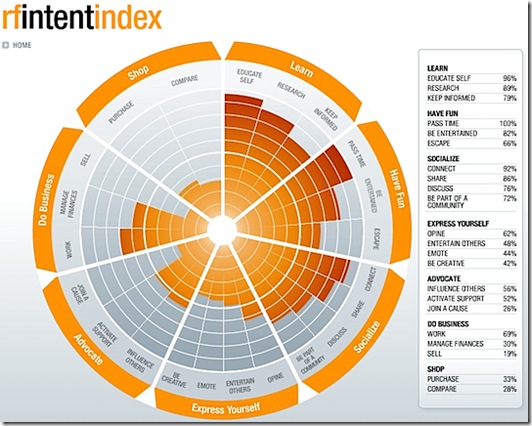
rfintentindex

This where Problogger got this image. 100% of this sample of 500 went online with the intention to pass time; in other words, they went online because THEY WERE BORED. However, only 26% of the sample went online because they wanted to join a cause. So, how do blogs and social media fit into promoting the idea of space habitation and recruiting more members into the space movement? Blogs about space habitation and blogs which talk about space habitation occasionally are very good at connecting to bored people who want to educate themselves or do research for fun. The very best blogs break down complex subjects and make them easy fro the average reader to grasp. If we could draw in a few bored (you have to be really bored to read my blog) people with space settlement blogs and educate them on the subject of space settlement, then we have planted a seed. They may not activate their support then and there, but they will not be opposed to the idea of space settlement with an effective blog; with an effective argument.

This is why I believe that whenever someone is against this idea of space settlement or against funding NASA or against manned space flight in general, it is my fault and the space community's fault. 96% of the people who go on the Internet go on the Internet with the intention for educating themselves. We have to grab that by the horns, we have a audience who will stay around if we teach them because they want to be taught. Blogs, with their oven fresh content, keep bringing in these people who want to learn. Blogs tap into this wandering student; the common Internet user don't wander to NASA's website. Ok, maybe some do, but blogs are geared toward this wandering audience because are jobs is to translate technical writing into non-technical writing. The common Internet user is less likely to wander into a NASA study and read it then a blog reporting on the study. Hopefully, the blog will present the study in a way that the wonderer will read.

What social media and blogs provide the space community with is one of the most effective tools we could ever have; we can provide anyone with the slightest interest in space settlement an expert in the field, or at least a space cadet like me, to have a one-on-one conversation. Recently, I got a Google alert from someone asking on his Live Journal "what's the point of space settlement". I was able to tweet this request and get the many space cadets on twitter to give him an answer, a very clear answer. That's the power we hold with the tools the Internet provides us. We can also craft a more convincing argument for space settlement...

And the premise of "The Wisdom of Crowds" is that, under the right conditions, groups can be remarkably intelligent. And they can actually often be smarter than even the smartest person within them. The simplest example of this is that if you ask a group of people to do something like, guess how many jelly beans are in a jar. You know, if I had a jar of jelly beans, and I asked you to guess how many jelly beans were in that jar,  your average guess would be remarkably good. It would be somewhere probably within three and five percent of the number of beans in the jar,  and it would be better than 90 to 95 percent of you. There may be one or two of you who are brilliant jelly bean guessers, but for the most part the group's guess would be better than just about all of you. And what's fascinating is that you can see this phenomenon at work in many more complicated situations.

So, for instance, if you look at the odds on horses at a racetrack, they predict almost perfectly how likely a horse is to win. In a sense, the group of betters at the racetrack is forecasting the future, in probabilistic terms.  ~James Surowiecki on the turning point for social media

You see, with all these blogs about space and space settlement, we will find out what the public likes and does not like. We can demo new ideas and the ideas which fail are not the ones which will make space settlement reality. In fact, the best blog post submitted for Space Settlement Blog Day should be turned into a pamphlet because it will be one of our better arguments. But, we do have a problem...

So, the ant colony is a great model -- you have all these little parts that collectively add up to a great thing. But we know that occasionally ants go astray, and what happens is that, if army ants are sort of wandering around and they get lost, they start to follow a simple rule -- just do what the ant in front of you does.  And what happens is that the ants eventually end up in a circle. And there's this famous example of one that was 1,200 feet long and lasted for two days, and the ants just kept marching around and around in a circle until they died. ~James Surowiecki on the turning point for social media

So, blogs could bring the death of the space movement. We might end up retweeting and linking to a deadly idea for the movement. This can be adverted by making sure everyone knows where they are going, but the possibility is still there.

So, in short, blogs can create a discussion about space settlement and that is what will get this idea engrained in humanity's culture. If space settlement becomes a cultural goal of humanity, it is sure to happen.

Reactions

-What other disadvantages can blogs bring to the space movement?

-Have you participated in a discussion of space settlement on the web? How did it go?

Resources

"rfIntentindex" Ruder Finn Intent Index. rfrelate. Article date unknown. Web. 7/20/09

Surowiecki, James. "James Surowiecki on the turning point for social media" Nov. 2008. Online video clip. TED. 7/20/09.

In Case You Skimmed

-The people on the Internet are all willing to listen to our pitch

-Bored people tend to go to blogs

-Blogs and social media can create conversations about space settlement

-These conversations will make the space movement stronger

Creative Commons License

Saturday, July 18, 2009

What Do We Know About Space Habitation?

For my 100th post, I would like to ask this question: what do we know about space habitation? When I envision humanity's path to becoming spacefaring, I see a person walking towards a large object in the fog. We are very far away from this large building. Close enough to see that it is, most likely, a building or a boat. You can make out the rough shape of the object, you think. But, by no means can you say for sure what that object is. You have heard myths about a grand temple where the holiest of men gathers and this could be it. But, you do not know all the details of that object, it's name and it's purpose. It's color and it's appearance. You can not tell how well it is maintained from this distance, you just know it's large. You also know, from experience, that it's better to keep move forward then to stay in one place, so you walk towards this object. You follow myth and predictions, but you do not know.

I compare human's place in it's development to the first seconds of sunlight after the darkest part of night. You can make up the rough shapes of objects in the light, it's better then the pitch, black darkness, but you can not exactly tell. You can not read the licence plates and billboards outside your window. We are not even at the dawn of the space age, we are at the first few seconds of the space age's dawn (in terms of our development).

The dawn of the space age

You see, the space community has created tons of predicts on what space habitation will bring humanity. But, we do not know. We can only extrapolate based on what we see in this little bit of light. I think we must wait till the sun raises further on the dawn of the space age to know what benefits space habitation will bring us.

I want you to think about the first seconds of light that glowed on the interconnected age. How could the people who worked with and had passion for the telegraph realize that the idea of sending messages through wires would later change the very social fabric of humanity? Would collapse so many walls and change so many rules? Would they have seen would the telegraph lead to the Internet?

We are in a similar time period. A time period where we do not know what becoming a space faring species will bring us, how it will change us and how the human spirit will adapt to it.

Reactions

Am I off base? Can we predict what benefits space habitation will bring us from what we know now? Are we further along in the dawn of the space then the time I predicted (a few seconds in).

Resources

Photo by Steve took it

In Case You Skimmed

-Humanity is not experienced enough in space to know what space will bring us.

-We have enough date to make predictions.

Creative Commons License

Wednesday, July 15, 2009

Why the Neo-Nazi Mars Base Will Fail

While traveling in twitter land, I came across this little thing... The Mars Initiative. Now, you wouldn't believe me if I didn't quote the site, so I'm just going to let their words explain why the Neo-Nazis are planning are Mars base.

The objective that a Mars colonization plan would set for itself is daunting, so we should remind ourselves that we have a hundred years to fulfill it before our civilization becomes so decadent, impoverished and oppressive that the plan will become impossible for Western Man.  On the scale of hominid history we would be attempting to continue the evolution of humanity as a species, for the move into space will not be just a move for racial survival, in itself it will signify a human upgrade.  Any migration selects the best, leaving weaker members behind, and human migration into space will be no different. ~http://www.marsinitiative.org/

At first I was outraged. But, after unwilling following the blogging golden rule: "Do not post while outraged", I felt bad (for .00001 nano seconds) for the Neo-Nazis. This plan will fail pitifully and it seems like this is a desperate attempt by a dying organization to get attention. However, for this blog post, I'm assuming this idea is serious.

First, the space community is not supporting this in anyway. I've found the space community to be very sensitive to how its actions effect its public image. This is why Virgin Galactic turned down a $1 million dollar deal to shoot a pornographic film in space and why NASA is so squeamish about sex in space. It seems that the space community want to have a clean image, so, to protect this image, they will completely dissociate themselves from The Mars Initiative. No private space company will provide rockets to The Mars Initiative and NASA is just going to laugh at this idea. If The Mars Initiative were to build rockets themselves, they will have trouble accessing patented rocket technology.

At one time, the Neo-Nazis were prompting an idea to send all of the in the US African Americans "back to Africa". They planned to establish a racial colony in Africa. It's very ironic that all the racists are leaving Earth. It would be less weird if the Neo-nazis where telling all black people in the world to leave because, at least, they would be consistent with their historic tone. It really shows how much the Neo-Nazis are on the defensive.

Space exploration and expansion is for HUMANITY not INHUMANITY! ~biffgriff

I also think the Overview Effect will have a devastating effect on The Mars Initiative. Edgar Mitchell said the Overview Effect "gave him a profound sense of connectedness, with a feeling of bliss and timelessness. He was overwhelmed by the experience. He became profoundly aware that each and every atom in the Universe was connected in some way, and on seeing Earth from space he had an understanding that all the humans, animals and systems were a part of the same thing, a synergistic whole. It was an interconnected euphoria" (Universe Today). If the settlers of the Mars Initiative lose their racist opinions because of the overview effect, they will lose the support of their ground control who have not had this revelation and who have spend a lot of money to have a Mars colony devoted to their ideals. If those ideals of racial purity are lost in space, then I fear the Neo-nazi movement who remained behind will take violent action against the colonists. losing ground support would mean death of a crew in space

What if only a small minority of the crew of The Mars Initiative experience the overview effect? Then we could see the first war in space as the crew fights for the direction of the program. At the best, the tension on that ship and on the colony will be so high that the crew will be ineffective.

This idea, I fear, will be a huge mess if implemented. I wish the Neo-Nazi movement will die will the dawn of the space age. Hopefully, as more people see humanity as a united community, racism will die.

(Disclaimer: I'm black, so I'm biased on this topic)  

Reactions

Should the space community actively promote against this? Should we save them if the Overview Effect cripples their mission? Can NASA and other government space agencies stop them from launching? 

Creative Commons License

Sunday, April 26, 2009

SPC #6: Moon Bases as Initial “Space Society” Trials: Utilizing Astrosociology to Make Space Settlements Livable

Every Sunday, this blog will offer analysis of a paper on space habitation and other related topics. These are my opinions on a weekly scientific paper. They are subject to my perspectives and believes. I am open to debate, so if any reader believes I have misinterpreted something in a paper, please point it out. I'm only a student and learning how to read these papers and interpret them. All quotes are from the paper unless otherwise noted. All papers I review are available for free online.

This week we are covering the paper Moon Bases as Initial “Space Society” Trials: Utilizing Astrosociology to Make Space Settlements Livable

As we move away from simple orbital space missions and to missions that leave the earth's orbit, the importance of accounting of the crew's mental and emotional well being increases. We are already having difficulty addressing this need with the International Space Station. But, with a space colony, where people are living for years at a time, emotional and mental well being supersedes even the engineering around said space colony. We need to focus on how a social structure will develop on a place far, far removed from the historic social structures humanity have had.

Because of the isolated, long term nature of a space habitation effort, our previous methods regarding social interactions in space are ineffective. Any group who chooses to colonizes outside of this solar system, even outside Earth's planetary system, will not have the support of Earth in the event of a disaster. The people who you come with are the people who will be the factor that decides between life and death. Because of this, we must “evaluate the [social] issues involved with deep space settlement long before we have the technical means to reach such a location or construct a physical environment capable of operating without input from controllers on the Earth”.

Thus, the need for a new field; the need for Astrosociology, emerges. Astrosociology has a two-fold purpose. It studies the affect of becoming a spacefaring species on human society and the effect of being in space on the social interaction. In order for space habitation to occur successfully, the fields of Engineering and Sociology need to work together. Astrosociology acts as the bridge between the two fields. Engineers can not be the only professionals in the space movement. Yes, the technical aspects are important, but the human aspects of space programs must be considered, even prioritized.

The difference between Earth's society and any future space society demand research; demand consideration. A society is a group that exists to carry out the major functions of life, everything that we do socially is done to help our communities eat, sleep, excrete and reproduce; that is the point of our social function. That will be the point of sending more then one person to Mars. Since the obstacles to carry out those major functions of life are different in space then on Earth, the society that develops in will be much different.

Yes, a space society will develop on it's own, without planning. But, without planning, chaos is ensured. The wild west is the lesson that proves that we need a social plan for any space settlement. Crime and violence on a space colony, especially in it's early development, would be catastrophic.

A critical event will occur when the space settlement is first set up. Culture is handed down from generation to generation within that area. The first generation will not have the lessons of the past to stand on in space. The first space settlers will bring their own cultures to space. Assuming space settlement is a international project, all of Earth's cultures will mix in space. The mixing may cause conflict. Luckily, we have years of sociological research to avoid such conflict.

[Last updated: April 26, 2009]

Related Posts with Thumbnails